 Back to articles

Merge Alternatives: Our Review of the 10 Best Merge Competitors (Ampersand, HotGlue, and More)
A deep comparison of unified APIs, embedded iPaaS, and deep integration infrastructure for enterprise SaaS teams

Chris Lopez
Founding GTM
Merge Alternatives: Our Review of the 10 Best Merge Competitors (Ampersand, HotGlue, and More)
TL;DR
- Merge works well for shallow, standardized integrations but hits limits when enterprise customers need custom objects, complex field mappings, or real-time sync
- The biggest Merge limitation: unified APIs force a lowest-common-denominator data model. Custom Salesforce objects? You're stuck with passthrough workarounds.
- Vendor lock-in is real: Merge holds your customers' OAuth tokens. Switching providers means asking every customer to re-authenticate. This can result in unhappy customers, churn, and an awful user experience.
- Ampersand leads for deep integrations: Custom field mappings, bidirectional sync, and credential ownership built into the architecture. You own the keys. You own the integration infrastructure.
- Other alternatives to Merge unified API: Paragon (workflow automation), Nango (open-source), Finch (HRIS specialist), Prismatic (low-code + code-native)
What is Merge and When is it a Good Choice?
Merge.dev is a unified integration platform that lets SaaS companies connect to third-party systems their customers use—CRMs, accounting tools, HRIS platforms, and more—through a single common API. Instead of building and maintaining separate integrations for each system, you build once against Merge’s unified data model and get coverage across many tools in the same category.
This approach works well when speed and breadth matter more than depth. Unified APIs like Merge are designed to help teams ship many integrations quickly, as long as customer requirements fit within standardized data models.
Merge is typically a good choice when:
- You need broad integration coverage across many tools in a category
- Your workflows are primarily read-only or read-heavy
- Standard objects and fields are sufficient (no need for custom objects or mappings)
- Scheduled syncs are acceptable for your product experience
- You primarily sell to SMB or mid-market customers with relatively standard setups
Where Merge and other unified APIs start to struggle is at the enterprise edge.
Enterprise customers often have heavily customized systems like custom CRM objects, proprietary fields, complex validation rules, and expectations around real-time data and writeback. These requirements don’t map cleanly to a lowest-common-denominator common data models.
Merge tends to struggle when:
- You need bi-directional sync with fine-grained write control
- Your product requires real-time or near-real-time data, not periodic polling
- Customers expect support for custom objects and custom field mappings
- Integration limitations are starting to block enterprise deals
- Credential ownership and migration risk become procurement concerns
In these scenarios, teams often outgrow unified APIs and look toward deep integration infrastructure or embedded iPaaS platforms that can handle enterprise complexity natively.
Signs You've Outgrown Merge
Before exploring Merge.dev alternatives, it helps to know whether you actually need one. Here are the warning signs:
Enterprise prospects need custom object support. Your sales team keeps hearing "we'd need you to sync with our custom Lead Score object." The common model doesn't cover it, and passthrough feels like a hack.
Passthrough requests outnumber unified API calls. You're paying for an abstraction layer you're bypassing.
Procurement asks about credential ownership. Enterprise security teams want to know: if we switch vendors, do our customers need to re-authenticate? With Merge, the answer is yes.
You need bi-directional sync with complex mappings. Reading data is one thing; writing back with field-level control is another. Common models make write operations tricky when field structures don't align.
Integration depth is blocking deals. When "we can't support that custom field" costs you a six-figure contract, the math on building deeper integrations changes.
Understanding Merge Alternatives (and Unified API Limits)
Common models are lowest-common-denominator by design. A unified "Contact" object can only include fields that exist across most CRMs. When a customer needs data from a custom Salesforce object, you're either using passthrough requests (defeating the unified API's purpose) or telling them it's not supported.
You don't own the credential keys. When customers authenticate through Merge, Merge holds the OAuth tokens. Switching vendors means asking every customer to re-authenticate—a migration tax that creates real lock-in.
Sync frequency has limits. Many unified APIs sync on fixed schedules. Real-time or near-real-time sync often requires enterprise pricing.
The best unified API alternatives span several categories:
- Deep integration infrastructure (like Ampersand): Built for custom objects, field mappings, and enterprise complexity from the start
- Embedded iPaaS (like Paragon, Prismatic, HotGlue): Workflow builders with pre-built connectors and customer-facing configuration
- Open-source platforms (like Nango): Code-first flexibility with self-hosting options
- Vertical-specific unified APIs (like Finch, Codat): Deep coverage in one domain rather than broad coverage across many
The 10 Best Merge.dev Alternatives in 2025
1. Ampersand
Quick Overview
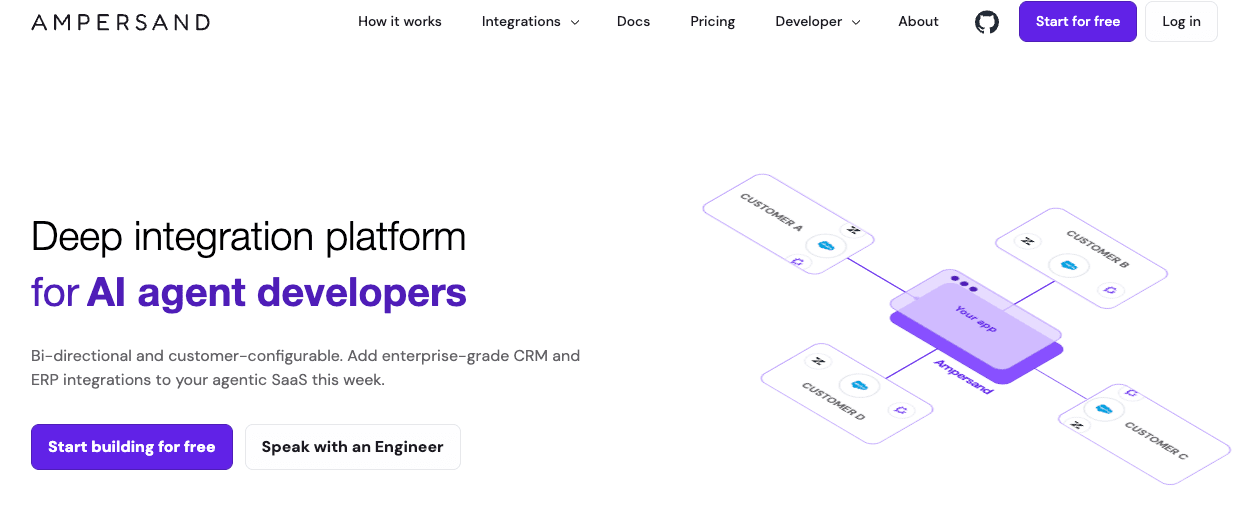
Ampersand is a deep integration infrastructure platform built for developers who need to go beyond common data models. Rather than forcing integrations through a lowest-common-denominator abstraction, Ampersand's architecture assumes complexity: custom objects, dynamic field mappings, bi-directional sync, and enterprise-grade configuration are first-class features.
The platform uses a declarative framework where integrations are defined as code—version-controllable, composable, and deployable through existing CI/CD workflows. With Ampersand, you get full access to any object or field (standard or custom) while the platform handles authentication, rate limiting, and infrastructure scaling.
Best For
Teams building enterprise-grade integrations where custom objects and complex field mappings are the norm. Browse the full provider directory to see supported integrations.
Pros
- Read or write any object or field. Standard or custom, Ampersand doesn't constrain you to a common model. See the write actions documentation for implementation details.
- Dynamic field mappings. Let your customers configure how their fields map to your system. Learn more about object and field mapping.
- You own the credential keys. Switch platforms without forcing customers to re-authenticate.
- Declarative, code-first framework. Version control, code review, CI/CD—all standard. Check the how it works guide.
- 200+ Open-source connectors. Ampersand’s connector library has open source integrations for Sales, Revenue, Marketing, Support, and more.
- Usage-based pricing. Pay for data delivered (GB), not linked accounts. See pricing details.
Cons
- Narrower category coverage than unified API giants. Ampersand prioritizes depth over breadth.
- Requires developer involvement. The power comes from code-level control.
Pricing
Free tier available (Launch plan includes 2GB of data delivery). Usage-based pricing scales with data volume. See current pricing.
Why Ampersand Ranks First Among Merge Competitors
Building great enterprise integrations is about depth. Common models work for SMB, but start to fall over at the enterprise level. Ampersand's bet is that custom objects and complex field mappings are the default for serious B2B integrations.
Ampersand’s credential ownership model addresses a serious problem many buyers overlook during procurement. When Merge holds your customers' OAuth tokens, switching vendors means re-authentication for every connected account.
2. HotGlue
Quick Overview
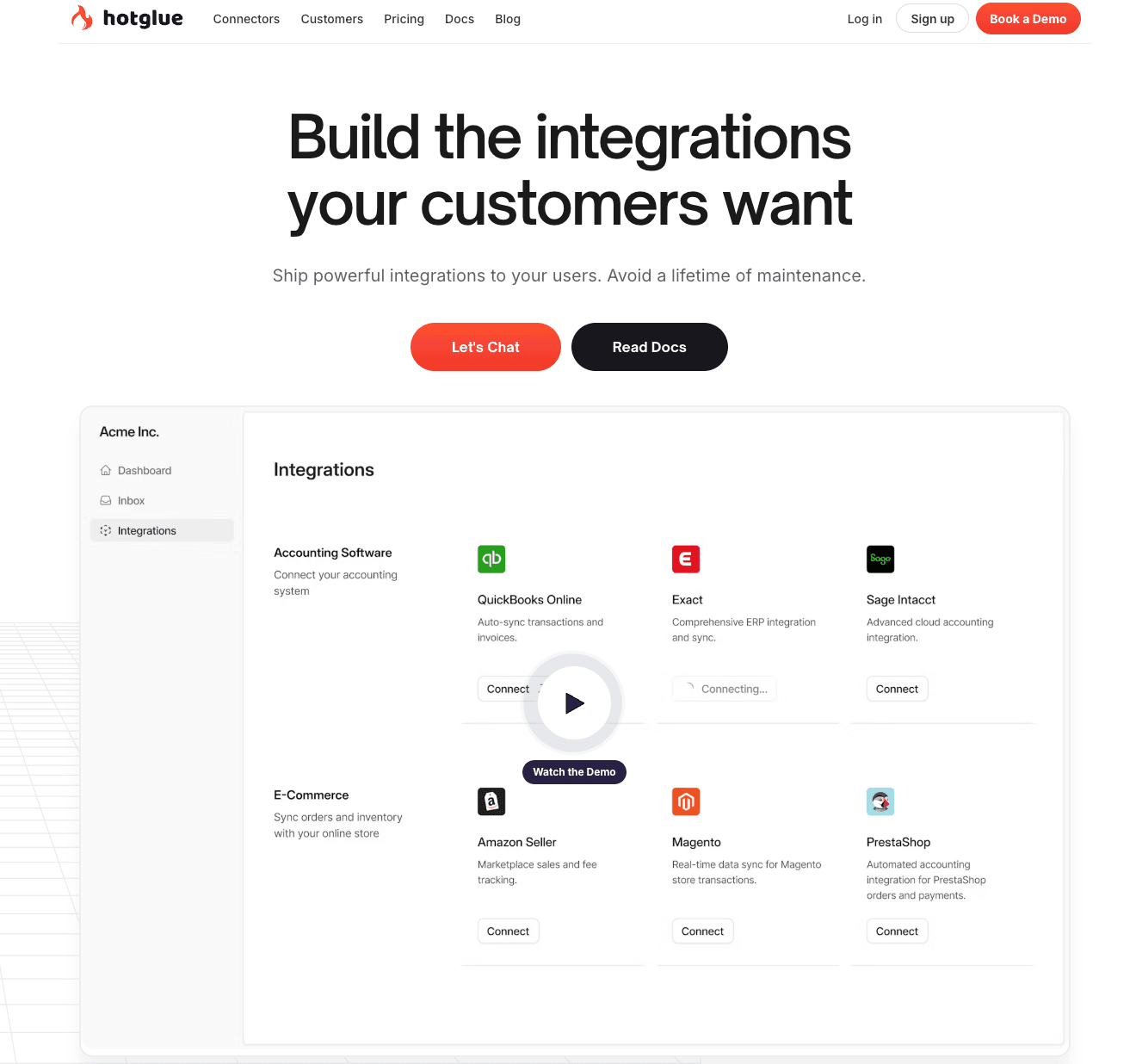
HotGlue is an embedded iPaaS built on open-source foundations with 600+ connectors compatible with Singer and Airbyte specs.
Best For
Teams wanting ETL-style embedded integrations with open-source connector flexibility.
Pros
- 600+ open-source connectors. Singer and Airbyte compatibility.
- Pass-through architecture. No customer data storage. SOC 2 Type II compliant.
- Python SDK for transformations. Custom logic when needed.
- Embeddable UI components. White-label widgets for React, JavaScript, Next.js.
Cons
- ETL-focused. Better for batch data movement than real-time bidirectional sync.
- More configuration required. Flexibility means more setup work.
Pricing
Contact for pricing.
3. Paragon
Quick Overview
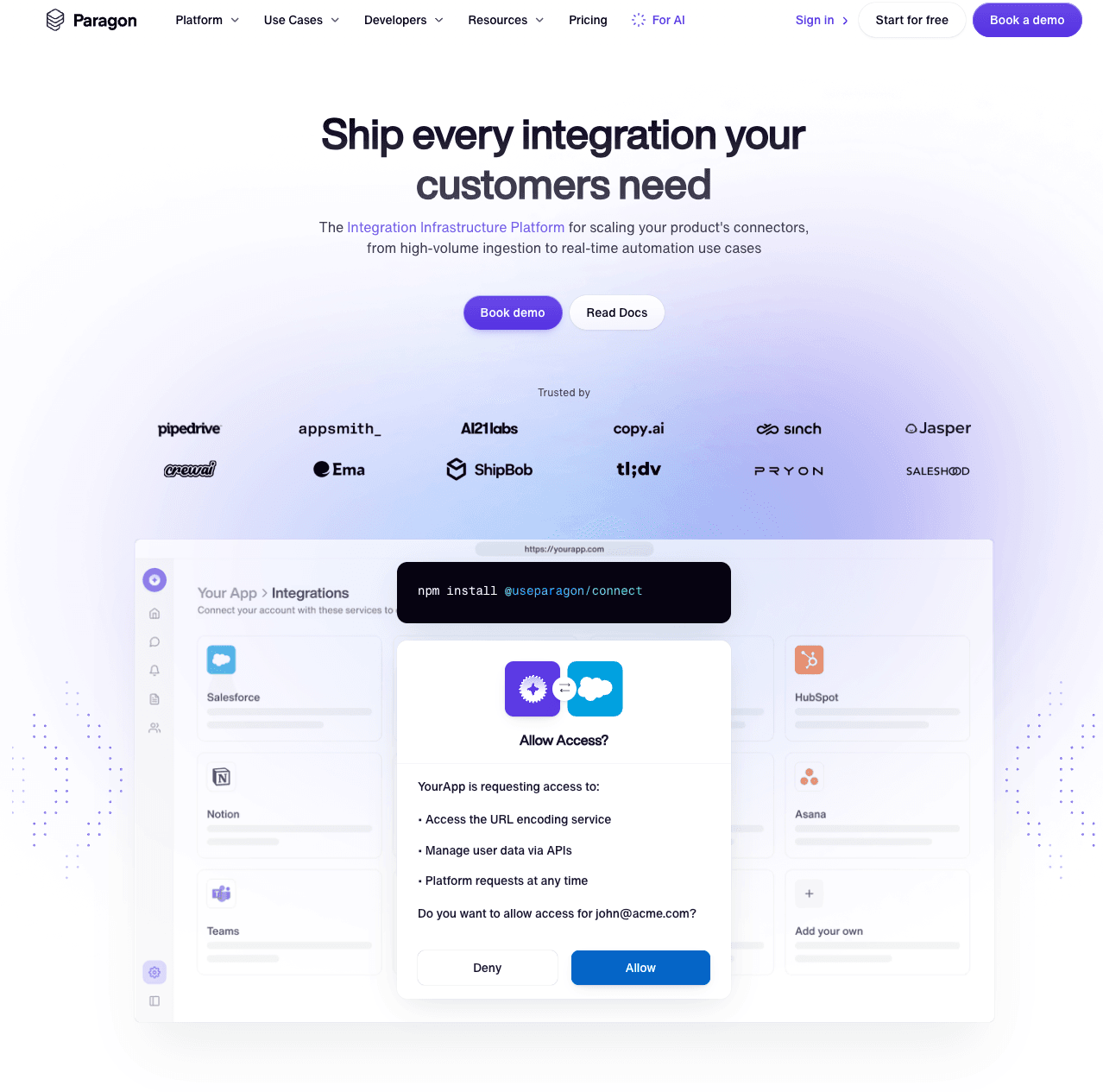
Paragon combines visual workflow builders with code-native flexibility. Offers 130+ pre-built connectors and tools for data ingestion (Managed Sync), real-time actions (ActionKit), and automations (Workflows).
Best For
AI and SaaS companies needing workflow automation alongside integrations. Strong for RAG pipelines and AI agent use cases.
Pros
- Visual builder + TypeScript SDK. Low-code for simple cases; Paragraph framework for code-native control.
- AI/RAG optimized. Built-in data ingestion pipeline support.
- Self-hosting option. Deploy on your infrastructure.
Cons
- Pricing scales with connected users. Can get expensive.
- Workflow-centric. May be overkill for simple read/write integrations.
Pricing
Starts at $35/month. Scales with connected users.
4. Nango
Quick Overview
Nango offers an open-source integration platform in addition to hosted services. Open source can be appealing for technical teams, but requires setting up quite a bit of infrastructure.
Best For
Developer teams wanting open-source foundations, code-first workflows, and self-hosting options.
Pros
- 500+ APIs, 28 categories. One of the largest API catalogs.
- Open-source core. Community contributions and self-hosting.
- Code-first architecture. TypeScript functions, standard dev workflows.
- Native 2-way sync. Bidirectional sync is a core feature.
Cons
- Self-hosted version has limited features. Full functionality requires cloud or Enterprise.
- Steeper learning curve. More upfront investment than point-and-click.
Pricing
Free tier for development. Usage-based for production.
5. Finch
Quick Overview
Finch is a unified API focused on employment systems—HRIS, payroll, and benefits—with 220+ supported systems. Their unified API documentation details the data model.
Best For
Companies specifically needing HRIS and payroll integrations. Benefits administration, 401(k) providers, HR tech.
Pros
- 220+ employment systems. Deepest HRIS/payroll coverage.
- Write capabilities. Create and manage deductions/contributions directly.
- Strong compliance. SOC 2, HIPAA compliant.
Cons
- Single vertical. Employment systems only.
- Daily data refresh. Not real-time for most integrations.
Pricing
Contact for pricing.
6. Codat
Quick Overview
Codat provides financial data APIs connecting banks and fintechs to accounting, banking, and commerce platforms. Their integration overview covers supported platforms.
Best For
Fintech companies and financial services needing accounting data integrations.
Pros
- Deep accounting coverage. Xero, QuickBooks, Sage, NetSuite, Microsoft Dynamics.
- Financial data models. Standardized for lending decisions.
- Two-way sync. Read and write financial data.
- Strong customer base. 300+ global clients.
Cons
- Narrow focus. Financial data only.
- Pricing requires sales conversation. No public pricing.
Pricing
Custom pricing.
7. Prismatic

Quick Overview
Prismatic offers low-code visual builders and full TypeScript SDK support.
Best For
B2B SaaS teams wanting embeddable integration marketplaces with both low-code and code-native options.
Pros
- Low-code + code-native. Visual designer and TypeScript SDK.
- Embeddable marketplace. White-label integration catalog.
- Strong deployment tooling. Version control, monitoring dashboards.
Cons
- Custom pricing only. Requires sales conversation.
- Can be complex. Full-featured platform may be overkill for simple needs.
Pricing
Custom pricing. Free trial available.
8. Unified.to
Quick Overview
Unified.to is a real-time unified API with 360+ integrations across 21 categories. Never stores customer data—every request hits the source system live. Their documentation explains the architecture.
Best For
AI-native products needing real-time data access without vendor data storage.
Pros
- 360+ integrations, 21 categories. Broad coverage.
- Real-time by default. No caching, no sync jobs.
- Zero data storage. Reduced compliance footprint.
- MCP tools for AI agents. Built-in LLM integration support.
Cons
- Real-time means more API calls. Higher costs for frequent access.
- Newer platform. Less market presence.
Pricing
Free tier available. Usage-based scaling.
9. Apideck
Quick Overview
Apideck offers unified APIs across CRM, HRIS, Accounting, ATS, File Storage, E-commerce with an integration marketplace builder.
Best For
Startups wanting unified API capabilities at a lower price point than Merge.
Pros
- Affordable entry. Launch plan at $299/month.
- Broad category coverage. CRM, HRIS, ATS, Accounting, File Storage, E-commerce.
- Real-time architecture. Fetches from source APIs directly.
- E-commerce support. One of few covering Shopify.
Cons
- Shallower integrations. Breadth over depth.
- Limited enterprise features. Fewer compliance certifications.
Pricing
Launch: $299/month. Growth and Enterprise tiers available.
10. Knit
Quick Overview
Knit emphasizes security with webhook-based architecture and zero customer data storage. Their comparison content provides landscape context.
Best For
Security-conscious teams wanting unified API convenience without data storage trade-offs.
Pros
- Zero data storage. Customer data never stored.
- Webhook-based architecture. Real-time notifications.
- Custom field mapping. Beyond common models.
- Transparent pricing. Starts at $399/month.
Cons
- Smaller integration library. Fewer total integrations.
- Newer platform. Less enterprise proof points.
Pricing
Starts at $399/month.
Summary Comparison Table
| Tool | Type | Sync Mode | Write Support | Credential Ownership | Starting Price |
|---|---|---|---|---|---|
| Ampersand | Deep integration | Real-time webhooks | Bi-directional | You own | Free tier |
| HotGlue | Embedded iPaaS | Scheduled + webhooks | Bi-directional | Vendor holds | Contact sales |
| Paragon | Embedded iPaaS | Webhooks + polling | Bi-directional | Vendor holds | $35/month |
| Nango | OSS | Webhooks + polling | Bi-directional | You own | Free tier |
| Finch | Vertical (HRIS) | Daily polling | Bi-directional | Vendor holds | Contact sales |
| Codat | Vertical (Finance) | Polling | Bi-directional | Vendor holds | Custom |
| Prismatic | Embedded iPaaS | Webhooks + polling | Bi-directional | Vendor holds | Custom |
| Unified.to | Unified API | Real-time | Bi-directional | You own | Free tier |
| Apideck | Unified API | Real-time | Bi-directional | Vendor holds | $299/month |
| Knit | Unified API | Webhooks (push) | Bi-directional | Vendor holds | $399/month |
Ready to build deeper integrations? Try Ampersand free →
Merge vs Ampersand: A Closer Look
When evaluating Merge vs Ampersand, the choice comes down to integration depth versus speed-to-market.
Merge excels at getting integrations live quickly. If your customers use standard configurations and your primary goal is checking integration boxes for sales conversations, Merge's common data models do the job, but the trade-off is flexibility. With Merge, you're constrained to what the unified model supports.
Ampersand takes the opposite approach. The platform assumes your enterprise customers have customized their systems. Custom Salesforce objects, proprietary HubSpot fields, complex data relationships—these are the default, not edge cases. Ampersand gives you full access to any object or field while handling the infrastructure complexity.
Owning your customers credentials matters much more than you’d think. Merge holds OAuth tokens for your customers' connected accounts. While Ampersand lets you own those credentials directly. If you ever want to move on from Merge, you’d need to reconnect all of your integrations just to switch providers. This vendor lock-in should be factored into your evaluation ahead of time rather than a regret you have later on.
Why Ampersand Is Leading the Deep Integration Space
Ampersand and the deep integration approach are the best option for companies building integrations for the enterprise. With Ampersand you get:
Credential ownership is structural. Most unified APIs hold OAuth tokens by architectural necessity. Ampersand lets you own those credentials, eliminating vendor lock-in at the technical level.
Integrations are code. Ampersand's declarative framework means integrations live in your repo, go through code review, and deploy through CI/CD. For engineering teams, this is how software should work.
Enterprise complexity is the default. Custom objects, dynamic field mappings, bidirectional sync with field-level control—these aren't add-ons. They're core to how the platform works.
For teams selling to enterprises with customized systems, Ampersand offers integration depth that unified APIs structurally cannot match.
FAQs
Is Ampersand better than Merge?
For teams needing deep integrations with custom objects and fields, yes. In the Merge vs Ampersand comparison, Ampersand supports enterprise complexity natively without passthrough workarounds and lets you own credential keys, eliminating vendor lock-in. Merge works better when customer requirements fit within common data models.
Does Merge create vendor lock-in?
Yes. When customers authenticate through Merge, Merge holds the OAuth tokens. If you switch to a different integration provider, every customer with a connected account needs to re-authenticate. This creates a migration tax that grows with your customer base. Platforms like Ampersand let you own the credentials directly, so switching providers doesn't require customer action.
How do unified APIs integrate with complex enterprise CRM implementations?
They struggle. Unified APIs work by mapping multiple CRMs to a common data model—a standardized "Contact" or "Deal" object that exists across platforms. But enterprise CRM implementations rarely fit this mold. Custom objects, proprietary fields, and years of configuration don't translate to common models. Most unified APIs offer "passthrough" requests as a workaround, but this bypasses the abstraction layer entirely. You're back to building custom logic for each integration, which defeats the purpose of using a unified API in the first place.
What integration platforms are the most developer-friendly?
Ampersand leads here. Integrations are defined using a declarative framework that lives in your codebase—version-controllable, deployable through existing CI/CD pipelines, and compatible with standard code review workflows. The platform treats integrations as software, not configuration. Prismatic offers a TypeScript SDK alongside its visual builder for teams wanting both options. Nango takes an open-source approach with integrations written as TypeScript functions.
What are the best unified API alternatives for enterprise integrations?
Ampersand leads for enterprise use cases requiring custom field mappings, complex object support, and credential ownership. Prismatic and Paragon are strong alternatives for light workflow automation needs.
What are the best Merge.dev alternatives for HRIS integrations?
Finch specializes in HRIS and payroll with 220+ employment system integrations—the deepest vertical coverage. Finch supports both read and write operations for employment-specific use cases.