 Back to articles

Your System of Record Just Became Multi-Consumer
Why Salesforce Headless 360 turns systems of record into multi-consumer platforms and what breaks when agents and humans write concurrently

Ayan Barua
CEO
Your System of Record Just Became Multi-Consumer
TL;DR: Salesforce's Headless 360 turns the System of Record tenant into a multi-consumer system where humans and multiple kinds of agents now write concurrently. The coordination problem this creates is the real engineering work of the agent era, and the major SoR platforms have not yet shipped the primitives for it. Workflows that used to run inside the SoR (Flow, Apex, Process Builder) are migrating into the agents themselves. The platform value proposition shifts from "run your logic here" to "reliable data layer your agents orchestrate against."
"Why should you ever log into Salesforce again?" Salesforce co-founder Parker Harris asked aloud ahead of the company's Headless 360 announcement,1 and the provocation has been widely read as a declaration that the UI is going away. The shipped architecture does not support that reading. Customer service reps still open the console. Admins spend hours in Setup configuring validation rules. RevOps lives in Lightning for pipeline reviews. The UI stays, because approvals and exception handling benefit from human judgment on a screen, and because the cost of retraining admins away from a decade of muscle memory exceeds what browserless purism would return.
What Headless 360 does recognize is that the UI is now one consumer among many on the same tenant. Your Salesforce org (and every other System of Record in your stack: NetSuite, Workday, HubSpot, ServiceTitan) has become a multi-consumer system. The customer's human employees in the UI, the internal agents built by the human's team, the enterprise agents the human hires from third-party vendors, and the SoR platform's own native agents are all hitting the same canonical data, workflows, and business logic, often within seconds of each other. Coordinating across those consumers is where the real engineering work of this cycle lives, and the major SoR platforms are only beginning to architect for it.
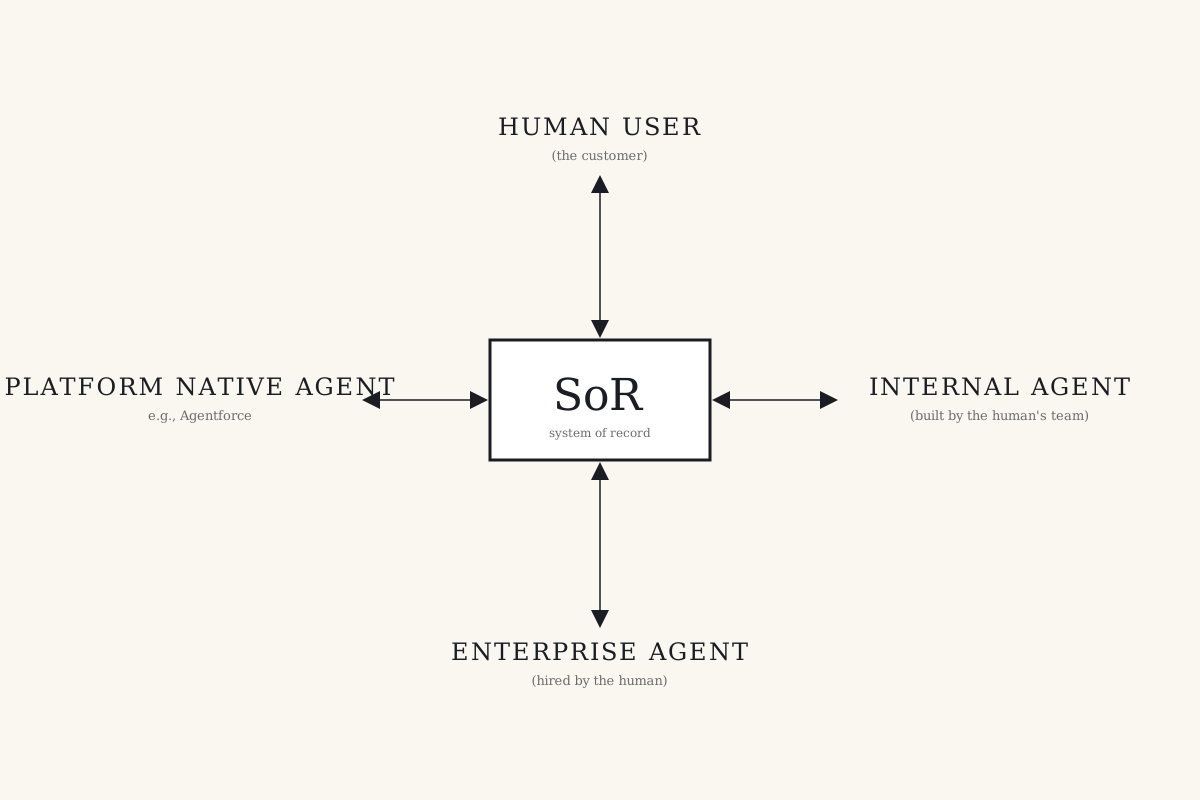
Who actually accesses your SoR tenant now
Until recently the consumer model was simple. Humans logged in through the UI. A few service-account integrations ran in the background. Coordination was easy because the integrations mostly read and the humans mostly wrote.
Headless 360 and its equivalents at HubSpot, NetSuite, Workday, and ServiceTitan change the consumer mix to something closer to this:
| Consumer | Identity / auth | Typical pattern |
|---|---|---|
| Human user (the customer) | Browser UI session | Setup, approvals, oversight, exception handling |
| Platform native agent (e.g., Agentforce) | In-tenant runtime, vendor-privileged | Summarize records, suggest next actions, draft responses |
| Internal agent | Customer-built, customer-owned OAuth | In-house automation built by the same team the human belongs to |
| Enterprise agent | Vendor-built, OAuth delegated by customer | Hired by the human, sold as products to many customers: AI SDRs, CS agents, GTM tools |
Two of these rows represent the customer's organization. The human user and the internal agent come from the same team: the human owns the workflow, the agent automates parts of it, and both are "the customer" in the tenant's audit log. The other two rows are vendor-provided under different privilege models. Platform native agents run inside the SoR with vendor-granted privileges. Enterprise agents run outside under OAuth credentials the human delegated to them when hiring the vendor.
The fourth row is where the competitive landscape is shifting. Enterprise agents are vendor-built products the customer hires to run against its SoR: AI SDR platforms pulling from Salesforce, autonomous customer service agents operating across Zendesk and Salesforce, GTM automation tools on HubSpot, procurement copilots on NetSuite. This category sits adjacent to the AppExchange ISV ecosystem, with one structural difference: the product ships as an agent operating on the SoR under delegated credentials rather than an app extending its surface. For the customer, each such hire becomes a new class of dependency that writes to canonical data and needs governance applied accordingly.
One clarification: these rows distinguish consumers by identity and how they authenticate, not by protocol. A single internal agent routinely mixes REST, MCP, webhooks, and CLI inside one workflow, and MCP is often a thin layer over REST endpoints humans have called for a decade. The coordination problems below apply uniformly across the four consumers, regardless of protocol.
What stays in the SoR, what moves out
A consequential architectural shift sits behind the diagram. Alfred North Whitehead wrote in 1911 that "civilization advances by extending the number of important operations which we can perform without thinking about them." Businesses are using agents in exactly that spirit: to execute operations that humans no longer need to attend to individually. The System of Record underneath is being reshaped to accommodate that delegation.
A System of Record like Salesforce historically did more than hold data. Apex triggers, Process Builder, Flow: process logic executed inside the platform, and the consumer was a thin client driving a thick SoR.
In the agentic model this inverts. Agents carry their own process logic. An AI SDR agent's workflow ("research lead, draft email, follow up, update the Opportunity") lives in the agent's reasoning loop, not Salesforce Flow. An internal agent might orchestrate across Salesforce, Gong, and Slack in one workflow, which no single SoR's engine can coordinate.
The SoR retains canonical data, hard invariants, identity, and audit. Business process orchestration, cross-system coordination, and soft rules that depend on reasoning migrate out to the consumers. The vendor's value proposition shifts from "run your logic in our platform" to "we are the reliable data layer your agents orchestrate against." Salesforce shipping Flow and Agent Script side by side at TDX suggests the industry is hedging between the two positions.
What breaks when many consumers share one SoR
Consider a plausible timing sequence. At 10:02am, a Gong-driven agent reads an Opportunity and begins preparing a stage update. At 10:03am, a sales rep in Lightning edits the same Opportunity's Close Date. At 10:04am, the agent's write lands with the original Close Date still in its payload. A custom validation rule that ties Close Date to Stage rejects the write with a validation_error string wrapped in a 400. The agent's reasoning loop reads validation_error as a schema problem and retries with a different stage value, then a third, before landing on "Closed Lost" on a pipeline opportunity worth several hundred thousand dollars. The audit trail attributes the change to a service account called agentforce_runtime that nobody on RevOps has heard of.
A skeptical reading is that the agent's retry logic is simply broken: interpreting validation_error as a schema problem and mutating the Stage field is bad engineering that would corrupt data regardless of coordination. Fair. Better agent error handling would prevent this specific incident. But the class of failures (concurrent writers producing corrupted state because they cannot see each other's edits) persists as the population of writers grows. Agent-side fixes address instances; platform-level coordination addresses the class. The coordination layer is incomplete across every major enterprise platform shipping today.
Multi-consumer tenancy on a System of Record is the real architectural shift. The endpoints were the three-year prerequisite.
The primitives a multi-consumer SoR actually needs
Five capabilities, none of which the major SoR platforms ship adequately today.
Record-level change subscription. When a human edits an Opportunity, every agent with an active reasoning loop about it needs to know within seconds. Change data capture today is an analytics feature with minute-scale delays. It needs to become a real-time primitive with tenant-scoped topics, replay support, and sub-second latency.
Agent identity fan-out. One human principal now maps to many agent identities acting on their behalf. Authorization becomes a question about which agent is acting for which user in which context, and existing permission models barely cover the user half. Agent identities need first-class status: scoped credentials, audit lineage back to a human, independent revocation.
Write intent declaration. Before an agent writes, it should be able to declare the write to the platform and receive confirmation that no conflicting human edit or other agent write is pending against the same fields. Compare-and-swap with version tokens handles the single-write case. Multi-step agent workflows benefit from a lease-like model: "I am going to update these three fields on this record within the next 30 seconds, tell me if that becomes unsafe."
Unified cross-consumer audit. Every write from every consumer, flowing into one audit log with the originating agent identity, the delegating human, the prompt or intent that triggered the action, the model version, and the full tool call payload. Salesforce's existing field history was built for human change rates. An active agentic workflow can plausibly drive 10 to 100x that volume; budget accordingly and pipe it somewhere queryable.
Agent-aware UI. For any workflow a human is expected to supervise, the UI needs to surface what the agents are doing. A pending write from an agent should render as a visible state in Lightning, alongside a record-level activity feed that treats agent actions with the same first-class status as human edits. Salesforce's Experience Layer gestures at this. Equivalents from other SoR vendors have not surfaced yet, and customers building UIs on top of those platforms will have to approximate it themselves.
Where this leaves you
If you are the engineering lead on a system integrating with a System of Record, the architectural question for this cycle is whether your workflows survive the human user, the platform native agent, your own internal agent, and an enterprise agent the human has hired all writing to the same Opportunity in the same hour. That is the real Headless 360 story, and no vendor has yet packaged it as a launch.
The endpoints shipped. Coordination across consumers has to ship before the failures it prevents become the thing your team cleans up for the next year.
Sources
The Opportunity-stage timing sequence is an illustrative worked example, not a report of a specific real incident. The five-primitive framing and the 10-100x audit volume estimate are the author's; they are not claims attributable to a published source.
Footnotes
-
Salesforce, Introducing Salesforce Headless 360. No Browser Required, April 15, 2026. The announcement ships more than 60 MCP tools and 30+ preconfigured coding skills, confirmed in independent coverage by VentureBeat, Constellation Research, and Salesforce Ben. ↩