 Back to articles

Best Marketing Automation Integration Platforms in 2026
Compare the best marketing automation integration platforms for Marketo, Klaviyo, Braze, Iterable, Customer.io, and Salesforce Marketing Cloud in 2026

Chris Lopez
Founding GTM
TL;DR
Customer-facing marketing automation integrations are more demanding than CRM integrations because campaign engagement events arrive at a much higher volume, each vendor exposes structures that common schema APIs often flatten, and many SaaS products also require paid media connectors for Facebook, LinkedIn, Pinterest, and Snapchat.
This guide compares five integration platforms for shipping Marketo, Klaviyo, Braze, Iterable, Customer.io, Salesforce Marketing Cloud, and other marketing automation connectors inside a SaaS product. Ampersand is the strongest option for teams that need deep, real-time marketing automation integrations with ad platform coverage.
What a marketing automation integration platform is
A marketing automation integration platform is the infrastructure a SaaS product uses to ship native connectors to tools like Marketo, Klaviyo, Braze, Iterable, Customer.io, Salesforce Marketing Cloud, and other marketing systems. The platform handles OAuth, webhook delivery, bulk operations, rate limits, retries, and field mapping across supported vendors, so engineering teams do not have to rebuild the same integration layer for every connector.
Marketers use Zapier-style workflows to connect tools inside their own accounts. SaaS teams use marketing automation integration platforms to embed those connections into the product experience, where each customer can authenticate their marketing tools, configure mappings, and run real-time or bulk operations. When the platform includes MCP support, the same connectors can also become callable tools for AI agents.
Why marketing automation integrations are harder than CRM integrations
Marketing automation integrations may look similar to CRM integrations because both require OAuth, webhooks, sync logic, and field mapping. The difficulty increases once campaign event volume, bulk subscriber operations, vendor-specific data models, and ad platform coverage are added to the integration roadmap.
Marketing events run at higher volume
Campaign engagement events such as opens, clicks, deliveries, bounces, and unsubscribes run at much higher volume than CRM record updates. A 10,000-contact CRM may create a few hundred change events per day, while the same customer base in Klaviyo or Braze can generate millions of engagement events across email, SMS, and push channels.
Polling architectures that work for CRM updates become harder to scale for marketing automation data. Long polling intervals reduce infrastructure cost, but they also delay campaign signals that marketing automation products, attribution tools, and AI marketing agents often need while customer interactions are still active.
Bulk operations are part of the core workflow
Subscriber list imports, segment writes, and historical event backfills are routine in Marketo, Klaviyo, Braze, and similar systems. When a new customer connects a marketing automation account, the SaaS product often needs to sync months of campaign history before the integration becomes useful.
Platforms built mainly around single-record reads and writes often treat historical backfills as exceptions. Marketing automation integrations need bulk operations as a supported part of the integration model, with rate limiting, retries, and error handling that hold up under high-volume subscriber and event data.
Vendor structures don't fit a common schema
Marketing automation tools expose data structures that do not map cleanly to a single shared model. Marketo programs, Salesforce Marketing Cloud data extensions, Klaviyo metric properties, Braze custom attributes, Customer.io traits and events, and Iterable user fields all carry vendor-specific meaning.
A common-schema API can work for shallow contact sync, subscriber lists, and basic campaign objects. The limits appear when a customer needs to write into an SFMC data extension, read a Klaviyo metric property, or preserve a Braze custom attribute without losing the vendor-specific structure.
Ads platforms belong to the same integration surface
For SaaS products built around campaign analytics, attribution, audience sync, or AI marketing copilots, paid media data should be grouped alongside email and automation data. Facebook, LinkedIn, Pinterest, and Snapchat ad spend, audience, and campaign data often sit within the same product workflows as data from Marketo, Klaviyo, Braze, and Salesforce Marketing Cloud.
Marketing integration platforms that exclude ads force product teams to maintain a second integration layer for paid media. A single integration surface across marketing automation and ad platforms gives engineering teams a cleaner way to support the full marketing data workflow.
5 best marketing automation integration platforms in 2026
1. Ampersand
Ampersand is a code-first integration platform for customer-facing marketing automation integrations. Engineering teams define integrations in declarative YAML manifests that live in Git, while Ampersand handles OAuth, webhook subscriptions, bulk operations, rate limits, retries, and field mapping across supported marketing tools.
Marketing automation connectors with vendor-specific depth
Ampersand supports Marketo, Klaviyo, Braze, Iterable, Customer.io, Salesforce Marketing Cloud, Brevo, Blueshift Campaign Monitor, Constant Contact, GetResponse, Kit, AWeber, SendGrid, Mailgun, Delighted, Livestorm, GoToWebinar, SurveyMonkey, Webflow, WordPress, and related variants such as Customer.io Journeys App, Customer.io Journeys Track, Customer.io Data Pipelines, and Blueshift EU. Marketo programs, Klaviyo metric properties, Braze custom attributes, and Salesforce Marketing Cloud data extensions map through Ampersand’s object and field mapping primitives, so SaaS products can preserve each vendor’s native structure.
Ad platform coverage in the same connector library
Ampersand also supports Facebook, LinkedIn, Pinterest, and Snapchat alongside email and automation connectors. Campaign analytics tools, attribution products, and AI marketing copilots can use a single integration platform to automate data and paid media data.
Sub-second event delivery through Subscribe Actions
Ampersand’s Subscribe Actions deliver webhook events in under one second through an event-driven architecture. 11x rebuilt its AI phone agent on Ampersand and cut CRM response time from 60 seconds to 5 seconds because Subscribe Actions push record changes as they happen. The same event-driven model applies to marketing automation integrations, where campaign engagement events arrive at much higher volume than CRM updates and AI marketing agents need fresh campaign signals during live interactions.
Bulk operations and embedded customer configuration
Ampersand exposes Read, Write, and Subscribe as composable primitives, with bulk list imports, segment writes, and historical event backfills handled in the same model as single-record operations. White-labeled React components for authentication and field mapping let each customer configure custom objects and fields without custom engineering work for every onboarding.
Open-source AI SDK and MCP server
Every marketing integration is exposed as callable tools for LLM agents through Ampersand’s AI SDK and MCP server. AI marketing copilots can read Klaviyo segment membership or write to Braze user attributes through standardized tool calls, without a custom function-calling layer for every model and provider. Ampersand also publishes 200+ open-source Go connectors that engineering teams can inspect, extend, or contribute to.
Credential ownership and regional connectors
Ampersand stores OAuth tokens under the SaaS team’s control, with import and export support for future migration needs. The Blueshift EU connector is available as a separate connector for teams supporting European customers with regional data residency requirements.
Best for: SaaS engineering teams shipping customer-facing marketing automation integrations across email, automation, and ad platforms, where vendor-specific depth, sub-second delivery, bulk operations, and customer-configurable mappings are core requirements.
Pros
- Marketing automation and paid media connectors in a single platform
- Native access to vendor-specific structures such as Marketo programs, Klaviyo metric properties, Braze custom attributes, and Salesforce Marketing Cloud data extensions.
- Sub-second event delivery through Subscribe Actions.
- Bulk operations for list imports, segment writes, and historical event backfills.
- Embedded React components for authentication and per-customer field mapping.
- AI SDK and MCP server for exposing connectors as LLM-callable tools.
- Declarative YAML manifests in Git with reviewable integration changes.
- Customer-owned OAuth tokens with import and export support.
Cons
- Connector coverage is narrower than broad unified API platforms that prioritize large cross-category catalogs.
- Declarative YAML configuration adds a short learning curve for teams used to visual builders or TypeScript-only integration logic.
Pricing: Free tier (2GB data, 5 customers, unlimited integrations). Catalyst plan at $999/month. Custom plans available for higher volumes. See pricing details.
2. Paragon
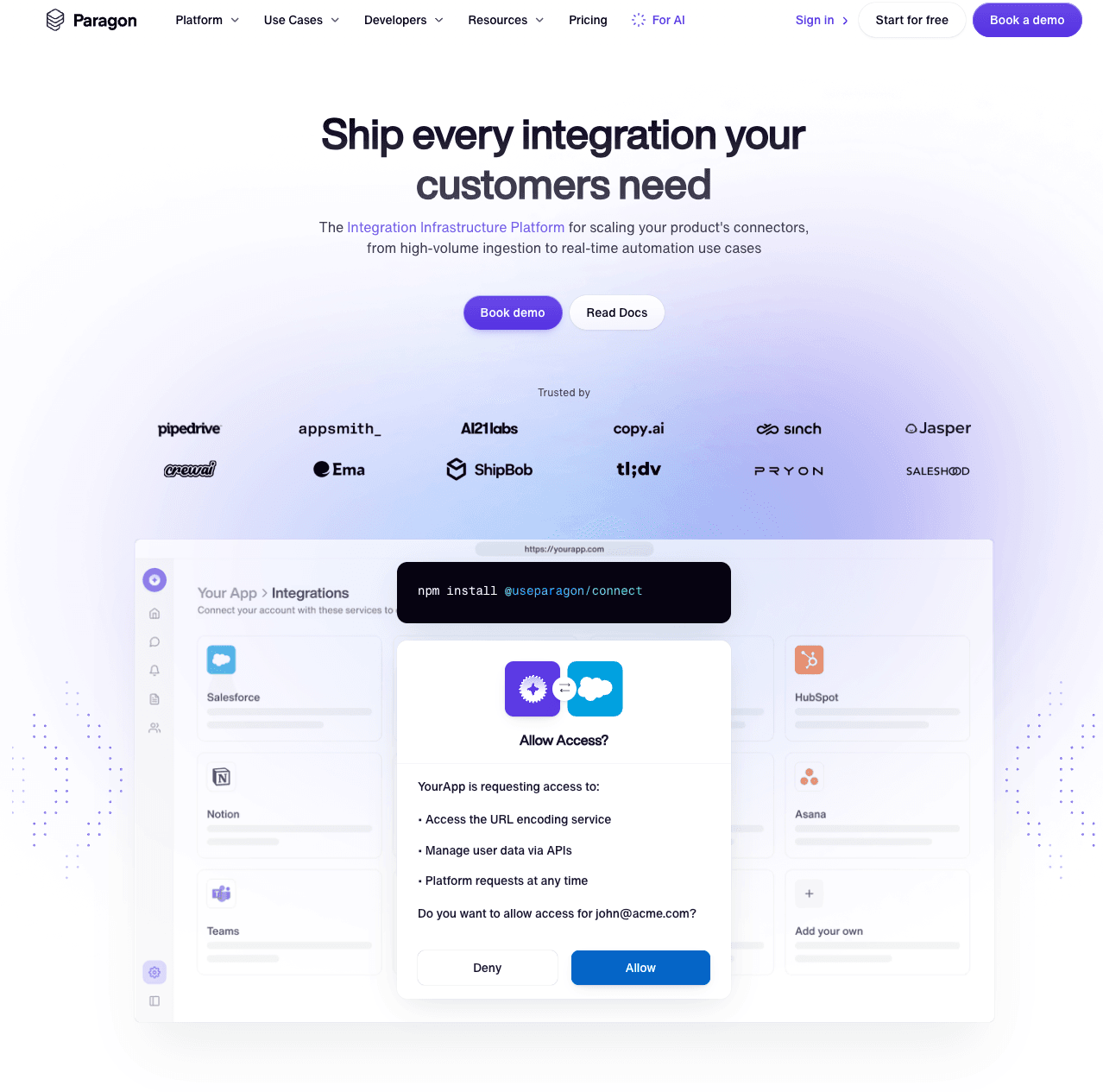
Paragon is an embedded iPaaS with a visual workflow builder for customer-facing integrations. It supports marketing connectors such as Marketo, Klaviyo, Mailchimp, and HubSpot, and its Connect Portal gives customers an embedded interface for discovering and authenticating integrations. Paragon also offers ActionKit for real-time actions and Managed Sync for higher-volume ingestion.
Best for: SaaS teams that want a visual workflow builder and embedded marketplace UI for customer-facing marketing integrations.
Pros
- Visual workflow builder for configuring integration logic.
- Embedded Connect Portal for customer authentication and integration discovery.
- Coverage for common marketing tools such as HubSpot, Marketo, Klaviyo, and Mailchimp.
Cons
- Visual workflow logic can sit outside Git-based review and CI/CD workflows.
- Ad platform coverage is narrower than Ampersand.
- Per-customer field mappings are tied to the Enterprise plan.
Pricing: A custom pricing model based on the number of connected users, with a free trial.
3. Merge
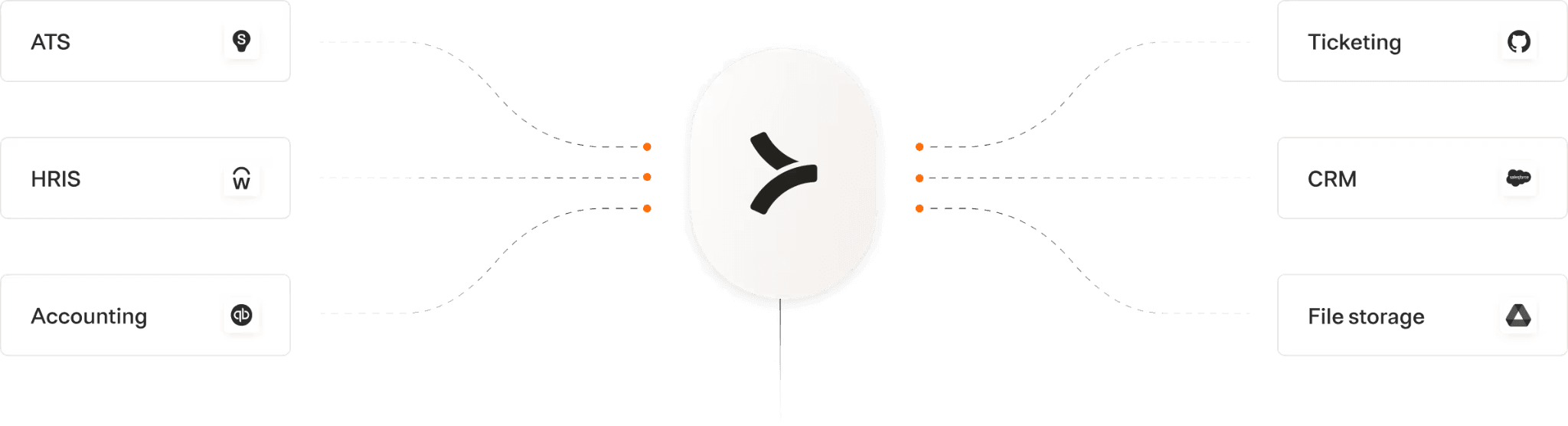
Merge provides a unified API with a common schema for marketing automation and other software categories. Its marketing automation coverage includes tools such as HubSpot, Mailchimp, Klaviyo, and ActiveCampaign through standardized objects for subscribers, lists, and campaigns. This model works for shallow sync across multiple tools, but vendor-specific structures such as Marketo programs, Salesforce Marketing Cloud data extensions, Braze custom attributes, and Klaviyo metric properties often require passthrough workarounds or fall outside the normalized schema.
Best for: SaaS products that need broad, shallow marketing automation sync via a single common-schema API.
Pros
- Single common-schema API across several email and automation tools.
- SDKs and documentation for faster first integration setup.
- Multi-category coverage across CRM, ATS, accounting, and marketing.
Cons
- Common-schema abstraction limits access to vendor-specific marketing structures.
- Ad platforms sit outside the marketing automation vertical.
- Many providers rely on polling-based sync and cache intervals.
Pricing: Free for up to 3 production link accounts. Launch plan at $650 per month for 10 linked accounts, with additional per-account charges. Professional and Enterprise tiers require annual contracts.
4. Tray
Tray is an embedded iPaaS used by products that serve enterprise marketing teams. It supports enterprise marketing systems such as Marketo, Salesforce Marketing Cloud, Eloqua, and Pardot, as well as ad platforms including Facebook, LinkedIn, and Google Ads. Tray fits larger organizations that want a workflow-based integration layer with enterprise governance features, but its visual workflow model places integration logic outside the Git-based workflows many engineering teams use for application code.
Best for: Products selling to enterprise marketing teams with Marketo, Salesforce Marketing Cloud, Eloqua, or Pardot-heavy stacks.
Pros
- Coverage for enterprise marketing automation systems such as Marketo, SFMC, Eloqua, and Pardot.
- Ad platform coverage across Facebook, LinkedIn, and Google Ads.
- Workflow engine with governance and audit features.
- Broad connector catalog across marketing, sales, and operations.
Cons
- Custom pricing can be harder to evaluate for early-stage or SMB-focused SaaS products.
- Visual workflow logic sits outside standard Git-based review and deployment processes.
Pricing: Custom pricing on request. Custom add-ons available.
5. Apideck
Apideck offers a multi-vertical unified API across CRM, accounting, ATS, and marketing. Its marketing automation coverage is smaller than Merge and follows a common-schema model, which fits products that need basic connector breadth without deep vendor-specific marketing objects. Apideck is a lighter option for shallow marketing integrations, but it has less per-vendor depth and minimal ad platform support compared with the other tools in this list.
Best for: Products that need a small set of shallow marketing automation integrations across common email and automation tools.
Pros
- Common-schema API across multiple software categories.
- Faster setup for basic marketing automation sync.
- Multi-vertical coverage across CRM, ATS, accounting, and marketing.
Cons
- Less marketing automation coverage than Merge.
- Limited access to vendor-specific marketing structures.
- Minimal ad platform support.
Pricing: Launch at $599/month. Scale at $1299/month. Enterprise plans are custom. Free trial available.
Best marketing automation integration platforms compared (2026)
| Platform | Vendor depth | Real-time delivery | Bulk operations | Customer-configurable UI | Ads platform coverage | AI-agent compatibility |
|---|---|---|---|---|---|---|
| Ampersand | ✅ Native objects, custom fields, and field mapping | ✅ Sub-second Subscribe Actions | ✅ Backfills, bulk writes, and segment operations | ✅ Embedded auth and field-mapping components | ✅ Facebook, LinkedIn, Pinterest, and Snapchat | ✅ AI SDK and MCP server |
| Paragon | ⚠️ Connector workflows and prebuilt actions | ✅ Workflow triggers and real-time ActionKit actions | ✅ Managed Sync with backfill and incremental sync | ✅ Connect Portal and field mapping | ✅ Google Ads, LinkedIn Marketing, and TikTok Ads | ✅ ActionKit API and MCP |
| Merge | ⚠️ Common Models with Field Mapping | ⚠️ Webhooks tied to synced common models | ⚠️ Initial sync and ongoing account sync | ✅ Merge Link and Field Mapping | ❌ Paid-media connectors are not part of the marketing automation surface | ✅ Agent Handler with MCP support |
| Tray Embedded | ✅ Enterprise marketing and GTM connectors | ✅ Event-driven, scheduled, and batch workflows | ✅ Batch workflows and pipeline automation | ✅ Embedded configuration and OAuth handling | ✅ Google Ads, Facebook, LinkedIn, and other marketing connectors | ✅ Agent Builder and Agent Gateway for MCP |
| Apideck | ⚠️ Unified Email Marketing API | ⚠️ Native and virtual webhooks | ⚠️ Standard API operations for email marketing resources | ✅ Vault UI and field mapping | ❌ Paid-media connectors are not part of the Email Marketing API | ⚠️ MCP server and API skills for supported APIs |
Ship deep, real-time marketing automation integrations with Ampersand. Start free today →
How we evaluated the best marketing automation integration platforms
Use the criteria below to evaluate whether each platform can support production marketing automation integrations at customer scale.
Depth per marketing automation vendor: The platform should support native structures such as Marketo programs, Klaviyo metric properties, Braze custom attributes, Salesforce Marketing Cloud data extensions, Customer.io traits and events, and Iterable user fields without flattening everything into a common schema.
Real-time event delivery: Campaign engagement events need webhook-based delivery with low latency, especially for AI agents, live personalization, attribution, and campaign analytics workflows that depend on fresh marketing signals.
Bulk subscriber and event operations: List imports, segment writes, and historical event backfills should be supported as core integration workflows, with rate limits, retries, and error handling designed for marketing-volume data.
Customer-configurable field mapping: End customers should be able to map their own Marketo program fields, Klaviyo metric properties, Braze custom attributes, and similar vendor-specific fields inside the SaaS product without opening a support ticket.
Ads-platform coverage: Facebook, LinkedIn, Pinterest, Snapchat, and other paid media connectors should sit close to email and automation connectors for products that handle campaign analytics, attribution, audience sync, or AI marketing workflows.
AI-agent compatibility: The platform should expose marketing connectors via an AI SDK, MCP server, or similar tool-calling surface, so agents can read and write marketing data without a custom function-calling layer for each provider.
A large connector catalog can still be shallow when the product needs vendor-specific objects, real-time delivery, bulk backfills, or AI-agent access. The strongest platforms for marketing automation integrations combine connector breadth with the infrastructure needed to support high-volume campaign data in production.
Why Ampersand leads the marketing automation integration category
Ampersand leads because marketing automation integrations need a code-owned layer for event volume, native marketing data, bulk workflows, customer-level mappings, paid media connectors, and agent access. Engineering teams define integrations in YAML, review changes through Git and CI/CD, preserve provider schemas, and expose connected systems through the AI SDK and MCP server.
In production, the complexity comes from customer-level variation and ongoing sync requirements. Each account can bring custom fields, historical imports, audience sync needs, regional requirements, and AI workflows that need the same connector to behave differently across tenants. Ampersand handles those account-specific differences through native object and field mapping, then supports the operational work around them with Subscribe Actions, bulk writes, backfills, and embedded customer configuration.
Companies including Crunchbase, Clarify, Warmly, and Clay rely on Ampersand for real-time customer-facing integrations. Start building native marketing automation integrations for free with Ampersand →
FAQs: Best Marketing Automation Integration Platforms (2026)
What is a marketing automation integration platform?
A marketing automation integration platform helps SaaS products ship native connectors for tools such as Marketo, Klaviyo, Braze, Iterable, Customer.io, Salesforce Marketing Cloud, and related marketing systems. It handles the shared integration work for each connector, including authentication, sync logic, rate limits, retries, and field mapping, so engineering teams can support customer-facing integrations without having to build every vendor connection from scratch.
How is a marketing automation integration platform different from a marketing automation tool like Marketo or Klaviyo?
Marketo, Klaviyo, and similar tools help marketing teams run campaigns. A marketing automation integration platform helps SaaS products connect to those customer-owned tools from inside the product. The platform provides engineering teams with the connector infrastructure, embedded authentication, sync controls, and a configuration layer needed to turn marketing data access into a native product feature.
Can my customers configure their own Marketo or Klaviyo field mappings inside my product?
Yes, if the integration platform supports customer-configurable mappings and gives you embedded UI components for configuration. Ampersand supports per-customer field mapping across all tiers, so customers can map custom marketing fields within your product without separate configuration work for each account.
Which platform supports real-time Klaviyo segment membership and Braze user attributes for AI marketing agents?
Ampersand is the strongest fit for AI marketing agents that need up-to-date marketing data in real-time workflows. Subscribe Actions support low-latency event delivery, while Ampersand’s AI SDK and MCP server expose connected marketing systems as callable tools for Claude, GPT, and other agents.
Do marketing automation integration platforms typically cover ad platforms like Facebook, LinkedIn, Pinterest, and Snapchat?
For products built around attribution, campaign analytics, audience sync, or AI marketing workflows, paid media connectors usually belong in the same integration layer as email and automation connectors. Ampersand includes Facebook, LinkedIn, Pinterest, and Snapchat, along with marketing automation connectors, helping SaaS teams avoid maintaining a separate integration surface for ad data.
How long does it take to ship a single marketing automation connector in-house vs. on a platform?
A production-grade Marketo, Klaviyo, or Braze connector built in-house typically takes one to two engineering quarters once OAuth, webhook delivery, bulk imports, retry logic, rate-limit handling, and per-customer field mapping are accounted for. The same connector on Ampersand can be defined in a YAML manifest and shipped in days, because the platform handles the underlying infrastructure across all supported vendors.
How is a marketing automation integration platform different from Zapier?
Zapier helps individual users automate actions across tools in their own accounts. A marketing automation integration platform helps SaaS teams embed those connections into their product and manage them across customer accounts. SaaS products use Ampersand when they need native connectors with customer-owned authentication, field mapping, real-time delivery, bulk operations, and agent access as part of the product experience.