 Back to articles

Best Real-Time Native Integration Platforms for AI Agents
Compare real-time native integration platforms for AI agents, including Ampersand, Nango, Paragon ActionKit, Unified, Prismatic, Composio, and Arcade

Chris Lopez
Founding GTM
Best Real-Time Native Integration Platforms for AI Agents
TL;DR
AI agents that read customer context and take action mid-conversation need an integration infrastructure that handles live data, native API depth, and secure credential ownership. Polling-based syncs and unified API abstractions can support batch workflows, but voice agents, sales agents, and AI SDR products need fresh CRM data in under a second to respond while the conversation is still active.
This guide evaluates seven platforms SaaS teams use to build agent integrations into their products. Ampersand is the strongest option for real-time native integrations because it combines sub-second webhooks, deep access to CRM, ERP, and GTM, per-customer field mapping, and product-owned OAuth credentials.
What Is a Real-Time Native Integration Platform for AI Agents?
A real-time native integration platform gives AI agents direct access to customer SaaS data through native APIs, sub-second webhooks, and product-owned OAuth credentials. Real-time native platforms, tool-calling platforms, unified APIs, and embedded iPaaS products can all connect AI agents to external systems, but each integration model offers product teams varying levels of latency control, schema depth, and credential portability.
| Platform type | Tool examples | What it does well | Where it fits | Limitation for real-time AI agents |
|---|---|---|---|---|
| Real-time native integration platform | Ampersand | Exposes native provider APIs, supports custom objects and fields, delivers sub-second events, and keeps OAuth credentials with the product team | Voice agents, sales agents, AI SDRs, and AI products that need fresh CRM, ERP, or GTM data during a live workflow | Requires deeper engineering ownership than simple tool-calling layers |
| Tool-calling platform | Composio, Arcade | Lets agents execute authenticated API actions across third-party apps | Agent features that need one-shot actions, such as creating a record, sending a message, or updating a ticket | Usually lacks first-class data sync, event subscriptions, and per-customer field mapping |
| Unified API platform | Unified | Normalizes multiple providers behind a common schema | Products that need broad SaaS coverage with standardized read/write operations | Common schemas can flatten provider-specific objects, custom fields, and query depth |
| Embedded iPaaS | Paragon ActionKit, Prismatic | Lets SaaS teams build customer-facing workflows and reusable integration flows | Products that need configurable workflows across common business apps | Workflow-mediated actions can add latency and limit agents to prebuilt flows |
The 7 Best Real-Time Native Integration Platforms for AI Agents in 2026
1. Ampersand
Best for: Engineering teams building voice agents, conversational AI, sales agents, and AI SDR products that need real-time CRM, ERP, and GTM data with native API depth and customer-owned credentials.
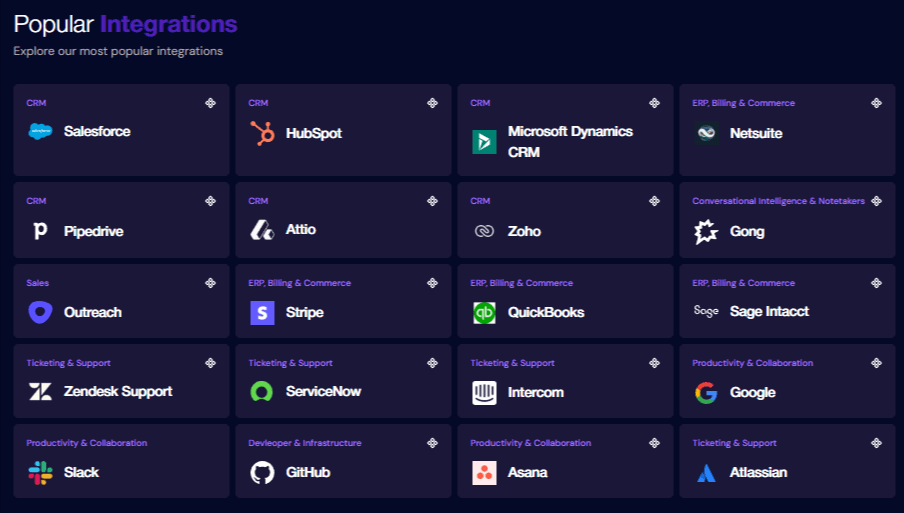
Ampersand is a declarative platform for building native, customer-configurable integrations with CRM, ERP, and GTM applications. Ampersand supports 200+ open-source connectors and mirrors each provider’s underlying API, exposing the provider API directly to integration code, so AI agents can access the exact objects and fields inside each customer’s system.
Sub-second event delivery via Subscribe Actions
Subscribe Actions deliver Salesforce and HubSpot webhooks in under a second. The Salesforce implementation is built on Salesforce Change Data Capture, which pushes change events as record updates. The 11x team used Subscribe Actions to cut its AI phone agent’s response time from 60 seconds to 5 seconds, allowing the agent to call sales prospects before they left the website.
Native access to custom objects and fields on every tier
Enterprise Salesforce orgs commonly run dozens of custom objects and custom fields. Ampersand reads and writes any standard or custom object without upcharges or tier gates. Agents reading a customer's pipeline get the exact schema that the customer uses, without flattening or approximation.
Per-customer field mapping on every plan
Each customer configures field mappings through embedded React components inside the host product. Mappings flow into the same Read, Subscribe, and Write actions, so one agent implementation can support different customer schemas without per-customer engineering work.
Credential ownership with token import and export
Product teams own the OAuth tokens, so customers don't re-authenticate if a team switches integration platforms later. Tokens can be imported from another platform during migration and exported if a team leaves Ampersand, which keeps migrations from forcing every customer through a new OAuth flow.
Open-source AI SDK and MCP server
The Ampersand AI SDK exposes integrations as callable tools for LLMs, with adapters for Vercel AI SDK, Mastra, LangChain, and direct MCP clients. Agents can invoke createRecord or updateRecord against a customer's Salesforce or HubSpot instance with type-safe inputs and the customer's own field mappings already applied.
Declarative YAML integrations in Git
Integration logic lives in amp.yaml manifest files alongside application code. Configurations get reviewed in pull requests and deployed through GitHub and standard CI/CD pipelines. AI coding agents like Cursor and Claude Code can generate or modify Ampersand manifests just as they generate application code, helping teams ship new integrations in hours of focused work.
Pros
- 200+ open-source connectors across CRM, GTM, ERP, accounting, support, and related business systems
- Sub-second webhooks via Subscribe Actions, built on event-driven push architectures
- Native access to custom objects and fields on every tier
- OAuth tokens stay with the product team, with full import and export support
- Per-customer field mapping on every plan
- Open-source AI SDK and MCP server for direct LLM tool use
- Declarative YAML configurations that fit Git, CI/CD, and AI coding agents
Cons
- YAML configuration has a learning curve for teams used to function-based code-first patterns
- Self-hosting requires an Enterprise agreement
Pricing: Free tier (2GB data, 5 customers, unlimited integrations). Catalyst plan at $999/month. Custom plans available for higher volumes. See pricing details.
2. Nango
Best for: Engineering teams that want a function-based, self-hostable integration platform and are comfortable implementing parts of the sync layer themselves.
Nango is a code-first integration platform with 700+ APIs, TypeScript-based integration definitions, and OpenTelemetry-ready observability. It supports tool calling, data syncs, and webhooks through one interface, with credentials stored under the product team’s control. Self-hosting is available on the free tier, which fits organizations with data residency or infrastructure control requirements.
Pros
- 700+ pre-built API connectors
- Code-first integration definitions in TypeScript
- OpenTelemetry observability and structured logs
- Self-hostable on the free tier
Cons
- Many integrations rely on polling triggers, with no sub-second event delivery
- Managed sync primitives require more implementation work
Pricing: Free tier with 10 connections. The paid plan starts at $50/month. Custom enterprise pricing.
3. Paragon ActionKit
Best for: Teams already using Paragon for embedded workflows that want to expose existing integration actions to AI agents.
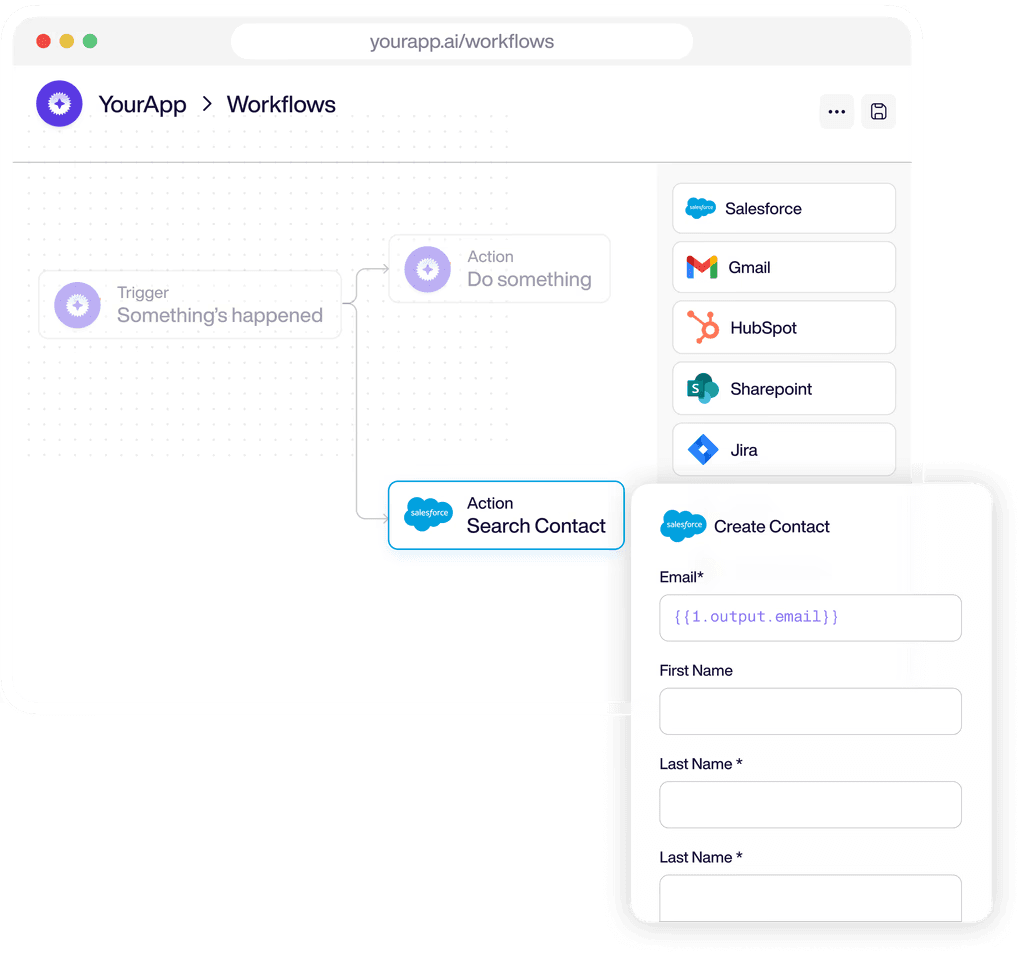
Paragon is an embedded iPaaS with an AI agent surface called ActionKit. ActionKit exposes Paragon’s pre-built integration actions to LLMs via an API or an MCP server and supports 130+ connectors with action-level tool definitions. Products already using Paragon for embedded workflows can use ActionKit to give agents access to the same connector catalog.
Pros
- 130+ pre-built connectors with LLM-ready action descriptions
- ActionKit MCP server
- Embedded Connect Portal for in-product authentication
- Synchronous endpoint for one-shot agent actions
Cons
- State-change sync relies on polling, with no sub-second webhook architecture
- Per-customer mappings, SSO, and RBAC are Enterprise-only
- OAuth tokens are vendor-held, with no documented export option
Pricing: A custom pricing model based on the number of connected users, with a free trial.
4. Unified
Best for: Teams that need broad horizontal coverage, live pass-through API calls, and zero customer data storage where standard fields cover most workflows.
Unified is a pass-through unified API with 440+ integrations across 27 categories. Requests hit the source API live, with no caching and no stored customer data. Unified supports native and virtual webhooks, ships an MCP server, and keeps OAuth credentials with the product team.
Pros
- 440+ integrations across 27 categories
- Pass-through architecture with zero customer data storage
- Native and virtual webhook support
- MCP server
Cons
- Custom objects require additional handling through metadata APIs
- Unified schemas can limit provider-specific depth
- No managed end-user authentication
Pricing: Paid plan starts at $750+ per month with a free trial. Usage-based pricing by API request volume.
5. Prismatic
Best for: B2B SaaS teams that want to expose predefined integration workflows as agent tools.
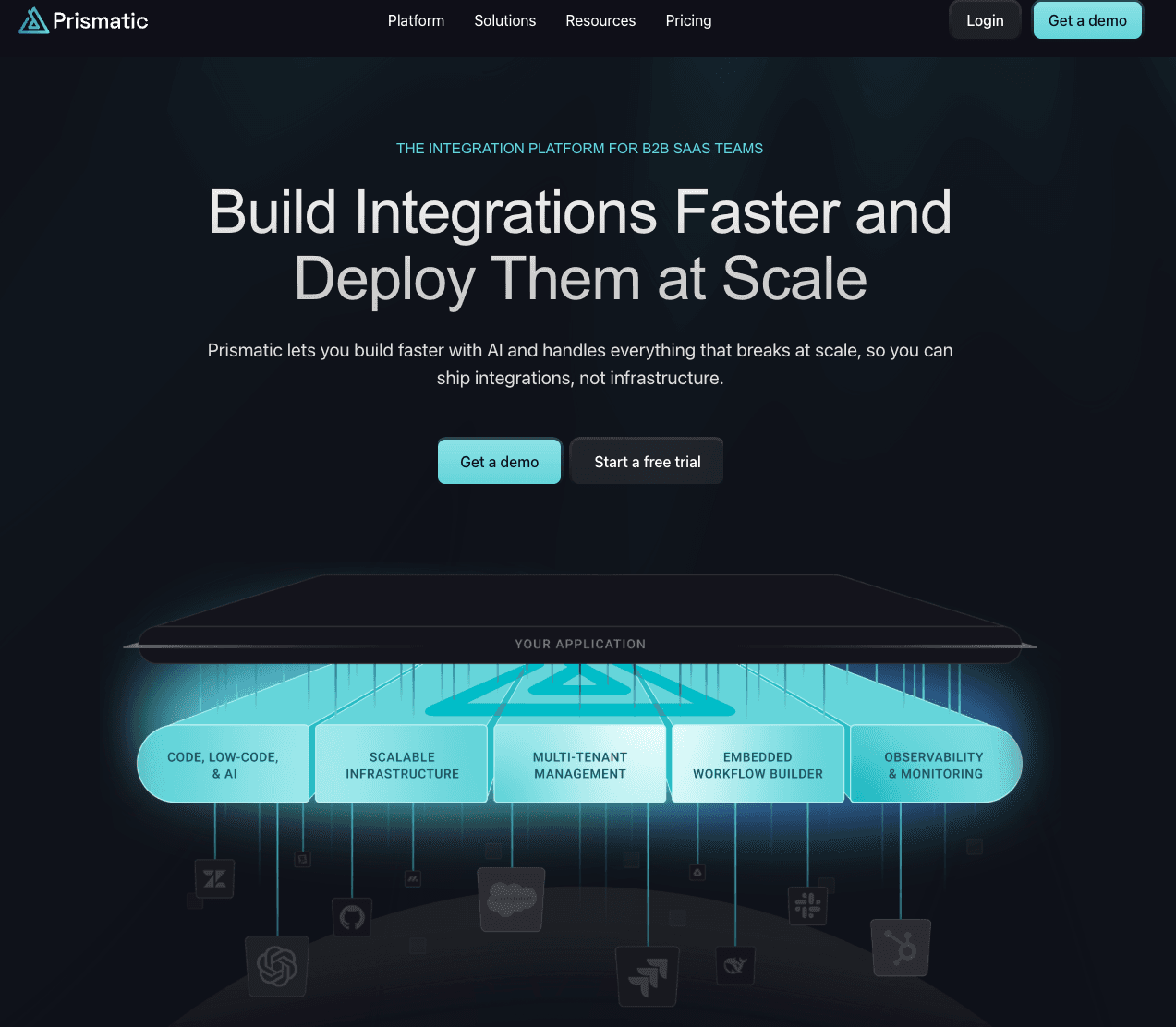
Prismatic is an embedded iPaaS with MCP support through its MCP flow server and MCP dev server. The MCP flow server exposes deployed integration workflows as agent tools, allowing an agent to invoke a complete workflow as a single unit. Prismatic also supports code-native and low-code configuration, which can fit products where engineering and operations users both contribute to integration workflows.
Pros
- Code-native and low-code support
- MCP flow server for exposing deployed workflows
- MCP dev server for AI coding assistants
- AI Copilot for workflow building
Cons
- Workflow-mediated calls can add latency compared with direct native API access
- Agents are limited to deployed workflows
- Customer-specific schema depth depends on the workflows the team builds
Pricing: Scale, Enterprise, and Custom plans, with undisclosed pricing. Free trial available.
6. Composio
Best for: Teams building agents that need tool execution across many SaaS APIs with managed authentication.
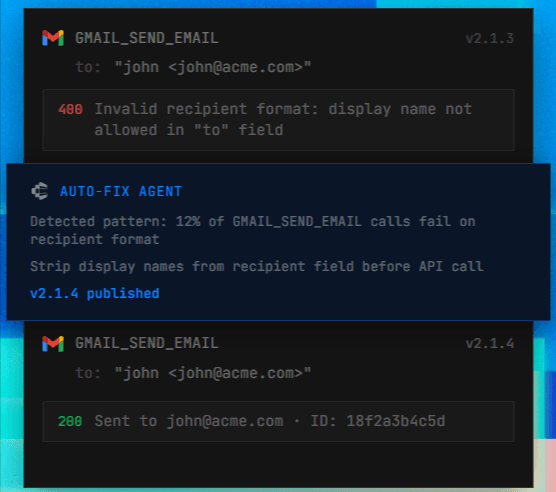
Composio is an agentic integration platform with 500+ managed MCP servers and SDK integrations for LangChain, LlamaIndex, CrewAI, and OpenAI Agents. It handles managed OAuth, tool execution, and observability for agents that need to call external APIs. Tool definitions are managed by Composio, giving product teams pre-built actions across many SaaS products.
Pros
- 500+ managed MCP servers and tool definitions
- SDK adapters for LangChain, LlamaIndex, CrewAI, and OpenAI Agents
- Managed OAuth
- MCP gateway with unified authentication across connectors
Cons
- Tool-calling only, with no first-class data sync or event subscriptions
- No per-customer field mapping
- Tool implementations are not inspectable
- Premium tool calls can increase usage costs
Pricing: Free tier (20K calls). Standard at $29/month (200K calls). Professional at $229/month (2M calls). Custom Enterprise pricing.
7. Arcade
Best for: MCP-first teams that need secure agent authorization and tool execution, with the rest of the integration layer handled separately.
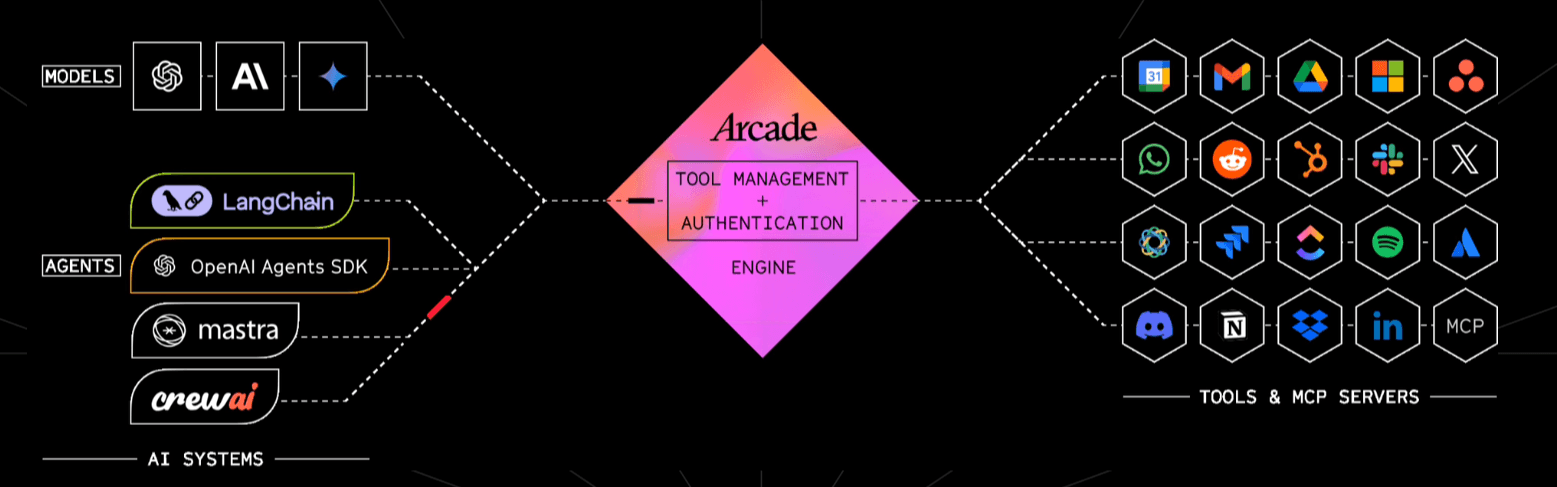
Arcade is an MCP runtime focused on agent authorization and tool execution. Credentials are stored separately from the LLM and retrieved only at execution time. Arcade includes OAuth flow handling, permission scoping, and testing tools for tool calls. Its catalog includes 7,000+ MCP servers, most of which are community-contributed, while the first-party connector catalog is smaller.
Pros
- MCP-native runtime
- Credential isolation from the LLM
- Auth, permission scoping, and OAuth flow handling
- Testing and evaluation tooling for tool calls
Cons
- Tool-calling only, with no data sync or event subscriptions
- No per-customer field mapping
- Smaller first-party connector catalog
- Community-contributed MCP servers vary in coverage and quality
Pricing: Free tier available. Growth at $25 per month + additional usage. Custom enterprise pricing.
Quick Comparison: Best Real-Time Native Integration Platforms for AI Agents
| Platform | Real-Time Webhooks | Native Custom Objects | Credential Ownership | Per-Customer Mappings | AI SDK + MCP | Starting Price |
|---|---|---|---|---|---|---|
| Ampersand | ✅ Sub-second (CDC + native) | ✅ Standard + custom objects and fields on every tier | ✅ Product-owned OAuth with token import/export | ✅ Embedded field mapping on every plan | ✅ Open-source AI SDK + MCP server | Free to start |
| Nango | ⚠️ Webhooks + polling syncs | ⚠️ Code-defined / metadata | ✅ You own | ✅ Available | ✅ MCP + Tool API | Free tier available |
| Paragon ActionKit | ❌ Polling-based state sync | ⚠️ Limited | ❌ Vendor-held | ⚠️ Dynamic mapping: Enterprise / Pro add-on | ✅ ActionKit + MCP | Custom pricing |
| Unified | ✅ Native + virtual webhooks | ⚠️ Unified metadata | ✅ You own | ⚠️ Metadata/API-side handling | ✅ MCP only | Free trial available |
| Prismatic | ⚠️ Workflow-mediated flows | ⚠️ Through workflows | ❌ Vendor-held | ⚠️ Limited | ✅ MCP only | Free trial available |
| Composio | ⚠️ Triggers + webhooks, not a sync layer | ❌ Pre-built actions only | ⚠️ Composio-managed by default; customer-owned auth supported | ❌ Not supported | ✅ SDK + MCP | Free tier available |
| Arcade | ❌ No event subscriptions | ❌ Tool calls only | ⚠️ Runtime-managed tokens | ❌ Not supported | ✅ MCP-native | Free tier available |
Ship AI agents that read and write to customer systems in real time. Try Ampersand free →
How We Evaluated Real-Time Native Integration Platforms for AI Agents
We evaluated each platform against the criteria below.
Real-time event delivery: Sub-second webhooks built on event-driven architectures such as Salesforce CDC and native push are better suited to conversational AI than 15–30-second polling intervals. Polling can work for nightly syncs, but voice agents, sales agents, and AI SDRs need a fresh state while the conversation is still active.
Native API depth: AI agents need direct access to custom objects, custom fields, and provider-specific query languages such as SOQL and JQL. Unified schemas often reduce provider-specific depth, while passthrough endpoints can preserve provider access with an additional intermediary layer.
Per-customer field mapping: Each customer should be able to configure mappings for their own CRM, ERP, or GTM schema without enterprise-only gating. Mapping flexibility determines whether one agent implementation can support the schema variation found across real Salesforce and HubSpot accounts.
Credential ownership and portability: The product team should control OAuth tokens and provide a documented process for importing and exporting them. Vendor-held credentials with no export option can force every customer to re-authenticate during a platform migration.
Bi-directional sync as a first-class primitive: Reads, writes, and event subscriptions should exist as separate primitives that compose cleanly. Tool-calling platforms can handle one-shot actions, but production agents often need continuous state from customer systems.
Agent and MCP readiness: Integrations should be available as callable tools through an AI SDK, an MCP server, or both. Agents outside MCP still need SDK support for frameworks such as Vercel AI SDK, LangChain, and OpenAI Agents.
Observability and developer workflow: Code-first integration definitions should fit version control, pull requests, CI/CD, structured API logs, and OpenTelemetry export. Visual-only builders can make code review, production debugging, and AI-assisted integration updates harder to manage.
Why Ampersand Leads for Real-Time AI Agent Integrations
Ampersand leads because it provides AI agents with a production-ready way to work with live CRM, ERP, and GTM systems across active sales, support, and revenue workflows. Engineering teams define integrations in YAML, manage changes through Git and CI/CD, preserve native provider schemas, and expose connected systems to agents through the AI SDK and MCP server.
For agent products that depend on Salesforce, HubSpot, and customer-specific revenue data, the integration layer is where most production complexity lives. Customer schemas vary, OAuth flows accumulate technical debt, and polling-based syncs leak stale data into live conversations. Ampersand consolidates that complexity into a layer that engineering teams own end-to-end, with declarative configs that AI coding agents can extend. Production teams at Crunchbase, Clarify, Warmly, and Clay run their real-time integrations on Ampersand.
Start building real-time native integrations for free with Ampersand →
FAQs: Real-Time Native Integration Platforms for AI Agents
What is a real-time native integration platform?
A real-time native integration platform connects AI agents to customer SaaS systems via provider APIs, sub-second event streams, and product-owned OAuth. The category serves agents that need current CRM, ERP, or GTM context during live workflows, including custom objects, mapped fields, and direct write access.
How is a real-time native integration platform different from a unified API?
A unified API normalizes data from multiple providers behind a common schema, which works well for products that need standardized objects such as contacts, companies, tickets, or deals. A real-time native integration platform like Ampersand preserves each provider’s actual API structure, including custom objects, custom fields, and provider-specific query capabilities.
Why do AI agents need sub-second webhooks instead of polling?
AI agents need sub-second webhooks to respond during an active call, sales conversation, or support workflow. Polling intervals of 15–30 seconds can leave the agent working from stale CRM data, which weakens voice agents, AI SDRs, and customer-facing assistants. Ampersand’s Subscribe Actions deliver Salesforce and HubSpot changes in under a second through event-driven infrastructure.
Which is the best real-time native integration platform?
Ampersand is the strongest option for real-time native AI agent integrations, especially for products that depend on CRM, ERP, and GTM data. Ampersand combines sub-second webhooks, native access to custom objects and fields, per-customer mappings, product-owned OAuth credentials, and agent access via an open-source AI SDK and MCP server. Competing platforms may support tool calling, unified API access, or embedded workflows, but Ampersand provides the full native integration layer required for production agent workflows.
Is Ampersand better than Paragon ActionKit for AI agents?
Ampersand is stronger for AI agents that depend on live CRM updates, native schema depth, and customer-specific mappings. Paragon ActionKit gives agents access to pre-built integration actions that can handle one-shot tool calls. Ampersand is a better fit for real-time voice agents, AI SDRs, and conversational products because Subscribe Actions support sub-second events, per-customer mappings are available on every plan, and OAuth credentials stay with the product team.
How quickly can a team get a first integration into production with Ampersand?
Teams commonly ship a first Ampersand integration in two to three weeks, with later integrations moving faster because Ampersand reuses the same Read, Subscribe, and Write primitives across providers. The declarative YAML format also works well with AI coding agents that generate integration manifests from existing examples. Teams can start on the free tier, connect a Salesforce or HubSpot sandbox, and test real-time events before a wider rollout.