 Back to articles

Best ATS Integration Platforms for AI Recruiting Tools
Compare the best ATS integration platforms for AI recruiting tools across real-time candidate updates, native ATS depth, field mapping, and agent access

Chris Lopez
Founding GTM
Best ATS Integration Platforms for AI Recruiting Tools
TL;DR
AI recruiting tools rely on ATS updates during outreach, scheduling, interviews, and scoring. The integration platform should deliver candidate status changes in seconds, preserve ATS-specific records and custom fields, support customer-level field mapping, and expose ATS reads and writes via MCP or AI SDKs.
This guide compares five ATS integration platforms for AI recruiting tools:
1. Ampersand: Best overall for AI recruiting tools that need sub-second candidate-status delivery, native ATS structures, embedded React field mapping, MCP and AI SDK support, YAML-defined integrations in Git, and customer-owned credentials.
2. Merge: Strongest when vendor breadth is the main requirement, with 20+ ATS connectors across modern, SMB, and legacy systems.
3. Paragon: For embedded ATS workflows built through Connect Portal, a visual builder, a code-first SDK, and ActionKit/MCP support.
4. Tray: For enterprise recruiting platforms where ATS integrations connect with broader automation across HRIS, communication, scheduling, and background-check systems.
5. Apideck: Fits multi-vertical SaaS products that need lighter ATS access alongside CRM, accounting, HRIS, and other unified API categories.
Why AI recruiting tools need different ATS integrations
AI recruiting tools have stricter ATS integration requirements because they act while candidates move through the hiring process. A stage change can affect the next outreach message, interview assignment, scheduling step, or scoring run, so the integration layer must quickly send ATS updates to the product while preserving sufficient source-system detail for the agent to make the correct decision.
The four requirements below explain what AI recruiting products need from an ATS integration platform.
Candidate-status webhooks need to arrive in seconds
Most unified API platforms sync ATS data on polling cycles. The sync interval may run every few minutes on aggressive settings and much longer on default settings, depending on the ATS and platform configuration.
For an AI outreach agent or conversational interviewer, even a short delay can create the wrong action. The agent may send a message based on an outdated stage, schedule a candidate who has already moved forward, or miss a follow-up after an interview has been booked. AI recruiting products need candidate-status events through native ATS webhooks so stage changes reach the product within seconds.
ATS data needs to keep its native structure
Every ATS models candidate, application, job, interview, scorecard, and stage data differently. AI scoring engines, candidate matching models, and interview copilots often depend on those source-specific structures.
Common-schema APIs can simplify basic reads and writes, but normalized records may remove details that AI features need. When the schema collapses ATS-specific context into generic candidate, application, or job objects, engineering teams often need workaround logic to recover the missing structure.
Customers need their own field and stage mappings
Enterprise customers rarely configure ATS fields, stages, scorecards, and hiring workflows the same way. One customer may use custom application questions, another may have team-specific stage names, and another may structure evaluation data around a custom hiring process.
An AI recruiting tool selling into many customers needs field and stage mapping inside the product experience. Embedded configuration lets each customer map ATS fields, stages, and scorecards without creating an engineering task for every account.
AI agents need direct ATS access
LLM agents work best when they can call ATS reads and writes through schema-aware tools with low latency. MCP servers, AI SDKs, and synchronous tool-calling APIs give agents direct access to candidate records, status updates, notes, and write operations.
Workflow builders can support automation use cases, but queued execution may add latency to agent interactions. AI recruiting tools need ATS access that stays close to the agent runtime, especially when the product is making outreach, scoring, or scheduling decisions during an active hiring workflow.
How we evaluated the best ATS integration platforms for AI recruiting tools
Use these criteria to compare how each platform supports AI recruiting workflows across customer ATS environments.
Depth per ATS vendor: The platform should preserve ATS-specific structures such as stages, scorecards, interview kits, custom fields, and custom objects without reducing everything into a generic candidate or job model.
Real-time candidate-status delivery: Candidate-stage changes should reach the product quickly enough for outreach agents, interview copilots, scheduling workflows, and scoring engines that act during an active hiring process.
Customer-configurable stage and field mapping: Each customer should be able to map ATS fields, stage names, and scorecard fields inside the product without creating an engineering task for every account.
ATS vendor breadth: The connector catalog should align with the ATS systems your customers use. Broad coverage becomes important when customers run long-tail, SMB, or legacy ATSes alongside modern systems.
AI-agent compatibility: The platform should support MCP servers, AI SDKs, schema-aware tool definitions, or synchronous tool-calling APIs, enabling agents to read and write ATS data directly.
The main buying decision is depth versus breadth. Some platforms preserve more source-specific ATS detail across fewer vendors, while others cover a larger ATS catalog through normalized schemas. The right platform depends on your customer base and the extent to which your AI features rely on source-specific ATS data.
5 best ATS integration platforms for AI recruiting tools in 2026
1. Ampersand
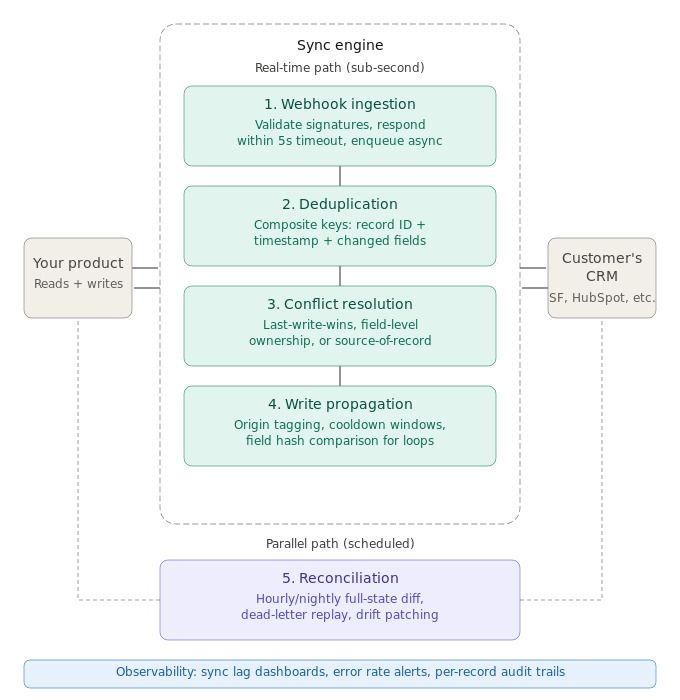
Ampersand is customer-facing integration infrastructure for AI recruiting tools that need deep ATS access across Lever, Ashby, and Greenhouse. It supports sub-second candidate-status events, native ATS data, tenant-level field mapping, agent access through MCP and AI SDKs, and code-owned integration configuration.
Native ATS depth
Ampersand mirrors supported ATS APIs directly and keeps source-specific recruiting data accessible through the relevant connector. Across Lever, Ashby, and Greenhouse, this includes applications, opportunities, postings, stages, interview kits, scorecards, rejection reasons, custom fields, and custom objects.
Native ATS depth gives AI recruiting products the context needed for scoring, matching, outreach, interview workflows, and reporting. Custom fields and custom objects are available on every tier, so teams do not need a separate Enterprise package to support customer-specific ATS data.
Sub-second candidate-status delivery through Subscribe Actions
Subscribe Actions deliver candidate-status changes via native ATS webhooks, typically within a second of the source system update. Ampersand handles webhook subscription setup, signature verification, retries, and adaptive rate-limit handling.
For outreach agents, scheduling assistants, and scoring workflows, faster status delivery reduces stale follow-ups and delayed handoffs when candidates move between stages.
Customer-configurable field mapping through embedded React UI
Ampersand’s InstallIntegration React component lets each customer authenticate their ATS, select fields, and map ATS data to the product’s internal schema inside the SaaS UI. Each mapping is stored per tenant, so customers can use their own stage names, custom fields, and evaluation fields without account-by-account engineering support.
MCP server and AI SDK for direct agent access
Ampersand provides AI recruiting agents with a structured way to work with ATS data via its MCP server and AI SDK. Agents can use schema-aware tools to read and update ATS records and make authenticated requests via the connected ATS provider.
For engineering teams, the AI SDK provides a tool layer for building sourcing agents, interview copilots, and outreach workflows on top of Ampersand’s connector infrastructure, keeping agent actions tied to the customer’s ATS connection without requiring a separate tool setup for every provider.
Code-first declarative configuration with credential ownership
Ampersand stores integration logic in amp.yaml manifests, which live alongside the application codebase. Teams can review connector settings, sync behavior, field mappings, and Subscribe Actions through pull requests, then deploy changes through existing CI/CD workflows.
OAuth tokens remain under the SaaS team’s control, with export support that helps teams avoid customer re-authorization during future infrastructure changes.
Best For: AI recruiting tools, talent SaaS products, and recruiting analytics products that need deep Lever, Ashby, and Greenhouse integrations with sub-second delivery, tenant-level mapping, and agent access.
Pros
- Native depth on Lever, Ashby, and Greenhouse.
- Sub-second candidate-status delivery through Subscribe Actions.
- Embedded React UI for tenant-level field mapping.
- MCP server and AI SDK for agent tool calls.
- YAML-defined integrations managed through Git and CI/CD.
- Customer-owned OAuth tokens with export support.
Cons
- The Public ATS catalog focuses on Lever, Ashby, and Greenhouse, so products that require long-tail ATS coverage may need a broader provider.
- Declarative YAML adds a short learning curve for teams used to visual builders or SDK-only integration logic.
Pricing: Free tier (2GB data, 5 customers, unlimited integrations). Catalyst plan at $999/month. Custom plans available for higher volumes. See pricing details.
2. Merge
Merge provides a unified ATS API that normalizes data from 20+ ATS vendors into common models. Its catalog includes systems such as Greenhouse, Lever, Ashby, Workable, Bullhorn, iCIMS, JazzHR, JobAdder, Manatal, and SmartRecruiters, which makes Merge useful when broad ATS coverage is the main buying requirement. The common-model approach provides products with a consistent way to work with candidates, applications, jobs, and related ATS records, but ATS-specific structures such as stage logic, scorecards, interview kits, and custom fields may require field mapping, pass-through access, or additional product logic.
Best For: AI recruiting products that need broad ATS coverage across modern, SMB, and enterprise recruiting systems.
Pros
- 20+ ATS connectors through one unified API.
- Coverage across modern, SMB, and legacy ATS vendors.
- Field Mapping for custom ATS data.
- Common models for candidates, applications, jobs, and related records.
Cons
- Common models can reduce access to ATS-specific structures.
- Real-time behavior depends on the source ATS and Merge’s sync model.
- Products that require deep AI workflows may need additional logic for normalized records.
Pricing: Free for up to 3 production link accounts. Launch plan at $650 per month for 10 linked accounts, with additional per-account charges. Professional and Enterprise tiers require annual contracts.
3. Paragon
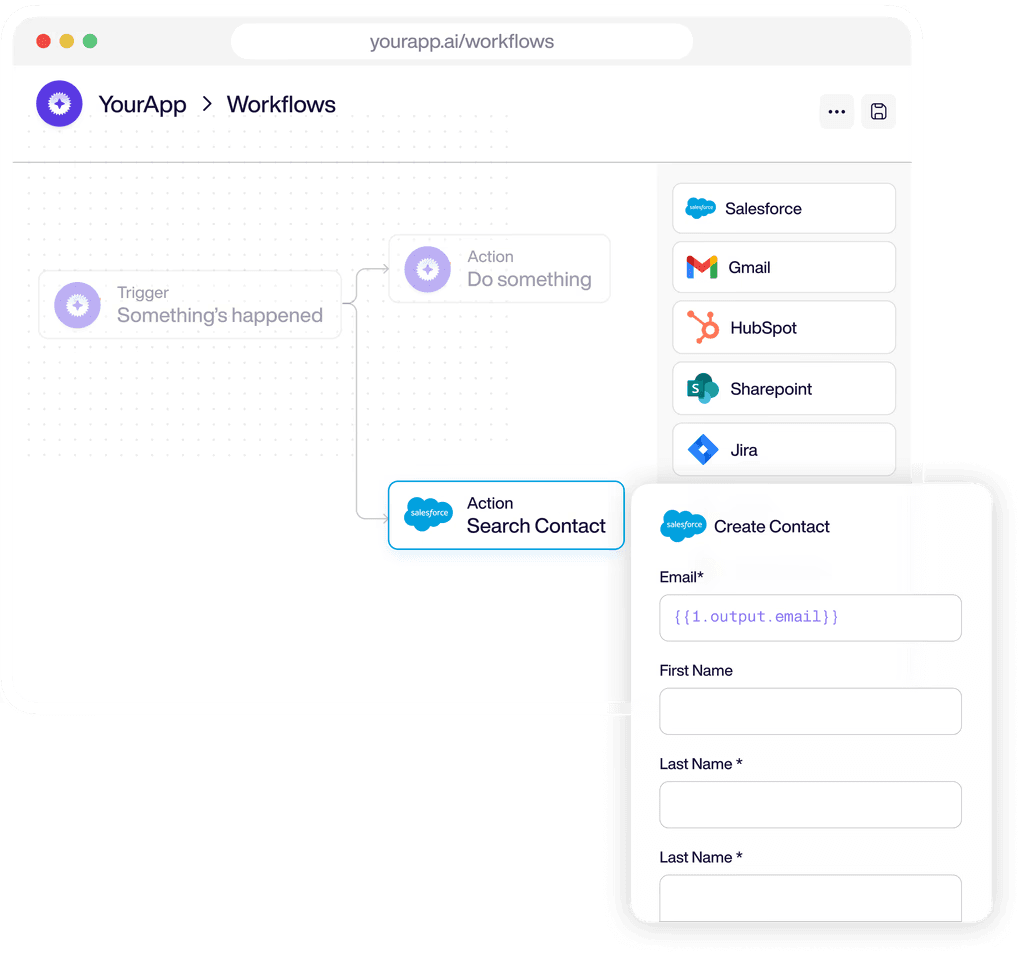
Paragon is an embedded iPaaS for customer-facing integrations. For ATS use cases, it combines a white-label Connect Portal, visual workflow builder, code-first SDK, and ActionKit for AI tool calling. Paragon supports ATS connectors including Lever, Greenhouse, and Workable. Paragon works when teams want a configurable integration workflow layer that non-engineering or solutions teams can help manage, while engineering teams still retain some code-level control through SDKs and GitHub sync.
Best For: AI recruiting tools that need customer-facing ATS setup through a visual workflow model.
Pros
- White-label Connect Portal for customer authentication and setup.
- Visual workflow builder for integration logic.
- Code-first SDK alongside the visual editor.
- ActionKit and MCP support for AI tool calling.
Cons
- Workflow execution can add latency to agent-driven use cases.
- The ATS catalog is narrower than that of broad unified API providers.
- Workflow-based pricing can create cost variability as usage grows.
Pricing: A custom pricing model based on the number of connected users, with a free trial.
4. Tray
Tray.ai is an embedded iPaaS and workflow automation platform with a broad connector library, universal HTTP connectivity, and enterprise governance features. Tray provides a broad connector catalog, including Greenhouse, as well as universal HTTP connectivity and connector-building options for additional APIs. Tray.ai fits products where ATS integration is part of a wider automation workflow across HRIS, communication, scheduling, onboarding, or background-check systems.
Best For: Enterprise recruiting platforms that need ATS integrations inside broader automation workflows.
Pros
- Workflow builder for multi-step recruiting and operations automation.
- Native connectors for common ATS workflows.
- HTTP Client and Connector Builder for additional API coverage.
- Governance, access control, and audit features for enterprise environments.
Cons
- Visual workflow execution can add overhead for low-latency agent actions.
- ATS-specific behavior depends on connector support and workflow design.
- Custom enterprise pricing can be harder to evaluate early in the buying process.
Pricing: Custom pricing on request. Custom add-ons available.
5. Apideck
Apideck offers unified APIs across ATS, CRM, accounting, HRIS, file storage, and other categories. Its ATS API provides products with a standardized way to work with recruiting data, while Vault handles authentication and connection management. Apideck also offers an MCP server for agent access across supported APIs. For AI recruiting products, Apideck is most relevant when ATS access is one part of a broader multi-vertical integration requirement.
Best For: Multi-vertical SaaS products that need lightweight ATS access alongside other unified API categories.
Pros
- Unified ATS API alongside CRM, accounting, HRIS, and other APIs.
- Vault for connection management and authentication.
- MCP server for supported APIs.
- SDK coverage across several programming languages.
Cons
- ATS connector catalog is smaller than Merge’s.
- Common models can flatten ATS-specific structures.
- Less specialized for AI recruiting workflows than ATS-focused platforms.
Pricing: Launch at $599/month. Scale at $1299/month. Enterprise plans are custom. Free trial available.
Quick comparison: Best ATS integration platforms for AI recruiting tools (2026)
| Criteria | Ampersand | Merge | Paragon | Tray.ai | Apideck |
|---|---|---|---|---|---|
| Depth per ATS vendor | ✅ Native ATS data, custom fields, and custom objects | ⚠️ Common Models with Field Mapping and Remote Data | ⚠️ ATS workflows and prebuilt actions | ⚠️ Workflow connectors with custom API options | ⚠️ Unified ATS models with passthrough and field mapping |
| Real-time candidate-status delivery | ✅ Sub-second delivery through Subscribe Actions | ⚠️ Webhooks plus polling-based sync | ⚠️ Workflow triggers and ActionKit actions | ⚠️ Webhooks, polling, and batch workflows | ⚠️ Native and virtual webhooks |
| Customer-configurable field mapping UI | ✅ Embedded React UI with field mapping | ⚠️ Field Mapping on supported plans | ✅ Connect Portal with field mapping | ⚠️ Workflow configuration and embedded setup | ✅ Vault and Field Mapping |
| ATS vendor breadth | ⚠️ Focused ATS coverage across Lever, Ashby, and Greenhouse | ✅ Broad ATS catalog across 20+ vendors | ⚠️ Focused prebuilt ATS coverage across Lever, Greenhouse, and Workable | ⚠️ Recruiting connectors plus universal API options | ⚠️ Unified ATS API across common ATS systems |
| AI-agent compatibility | ✅ MCP server and AI SDK | ✅ Merge Agent Handler | ✅ ActionKit MCP | ✅ Agent Gateway for MCP | ✅ Hosted MCP server |
| Code-first ergonomics | ✅ amp.yaml in Git with CI/CD deployment | ⚠️ API and SDK-based implementation | ⚠️ Visual builder with SDK support | ⚠️ Visual workflows with connector SDK options | ⚠️ Unified API with SDKs |
| Credential ownership | ✅ Customer-owned and exportable OAuth tokens | ⚠️ Merge-managed linked accounts | ⚠️ Paragon-managed connected accounts | ⚠️ Tray-managed connections | ⚠️ Vault-managed OAuth connections |
| Starting price | ✅ Free to start with unlimited integrations | ✅ Free for 3 linked accounts | ✅ Free trial available | ⚠️ Custom pricing | ✅ Free trial available |
Ready to ship deep, real-time ATS integrations for your AI recruiting product? Start building on Ampersand for free →
How to choose the right ATS integration platform
Start with the ATS systems your customers already use, then check how much your product depends on source-specific candidate, stage, scorecard, and interview data.
Ampersand is the best fit for AI recruiting products built around Lever, Ashby, and Greenhouse when real-time candidate-status delivery, native ATS structures, tenant-level mapping, MCP/AI SDK support, and code-owned configuration are core requirements. This fits outreach agents, interview copilots, scheduling workflows, and scoring systems that act on active candidate movement.
Merge makes sense when the customer base spans a wider ATS catalog. Products selling into iCIMS, Workable, Bullhorn, Workday Recruiting, and other long-tail ATS environments may need Merge’s 20+ vendor coverage before they optimize for source-specific depth.
Paragon fits teams that want customer-facing ATS setup through a visual workflow model. Its Connect Portal, workflow builder, SDK, and ActionKit/MCP support are useful when solutions teams, customer success teams, or end customers help configure integration workflows.
Tray is better suited to enterprise recruiting platforms where ATS integration is part of a larger automation layer across HRIS, communication, scheduling, background checks, and internal operations.
Apideck fits multi-vertical SaaS products where ATS access is one integration category alongside CRM, accounting, HRIS, and other unified API surfaces.
Why Ampersand leads the ATS integration category for AI recruiting tools
Ampersand leads because AI recruiting products require ATS integrations that keep candidate data usable in live-agent workflows. The integration layer must deliver stage changes within seconds, preserve source-specific ATS structures, support per-customer field mappings, and provide agents with schema-aware access to ATS records. Ampersand brings these requirements together through Subscribe Actions, native ATS depth, embedded React configuration, MCP support, and an AI SDK.
Ampersand is the strongest fit for products built around Lever, Ashby, and Greenhouse, where depth matters more than long-tail connector count. Its catalog focuses on the modern ATS stack, where AI recruiting tools often require stage transitions, scorecards, interview data, custom fields, and write operations to operate reliably across sourcing, outreach, scheduling, and scoring workflows.
Ready to ship deep, real-time ATS integrations for your AI recruiting tool? Start building on Ampersand for free →
FAQs: Best ATS Integration Platforms for AI Recruiting Tools (2026)
What is an ATS integration platform?
An ATS integration platform enables a SaaS product to read from and write to applicant tracking systems on behalf of its customers. It handles authentication, sync logic, webhook delivery, field mapping, and customer-specific configuration, so engineering teams do not have to build a separate integration layer for every ATS.
Can my customers configure their own Greenhouse, Lever, and Ashby field mappings inside my product?
Customers map their fields once through Ampersand's embedded React UI, and the configuration persists per tenant. When the customer later adds new custom fields in their ATS, the same UI lets them extend the mapping without filing a support ticket or pulling in your engineering team.
Which platforms support sub-second candidate-status webhooks for AI recruiting agents?
Sub-second delivery requires the integration layer to consume native ATS webhooks rather than poll on a schedule. Ampersand does this through Subscribe Actions for Lever, Ashby, and Greenhouse. Merge, Paragon, Tray, and Apideck mix native webhooks, virtual webhooks, workflow triggers, and polling depending on the source ATS, so candidate-stage changes can arrive anywhere from a second to several minutes after the source event.
Can AI recruiting agents call Lever, Ashby, and Greenhouse APIs directly through these platforms?
Several platforms support AI-agent access in different ways. Ampersand exposes ATS reads and writes via its MCP server and AI SDK, with schema-aware tools integrated with the connected ATS. Paragon supports agent tool calling through ActionKit and MCP, while Apideck offers a hosted MCP server across its unified APIs. Ampersand is strongest when the agent needs ATS-specific data structures for sourcing, outreach, scoring, or interview workflows.
How is an ATS integration platform different from internal automation tools like Workato or Zapier?
Workato and Zapier connect applications for a company’s internal workflows. An ATS integration platform powers customer-facing integrations inside a SaaS product, where each customer connects their own ATS through the product UI. Ampersand supports that customer-facing model with embedded configuration, tenant-level mappings, real-time sync primitives, and credential ownership across customer accounts.