 Back to articles

Best sales engagement integration platforms in 2026
Compare the top sales engagement integration platforms for AI sales products, including connector coverage, real-time sync, field mapping, and MCP support.

Chris Lopez
Founding GTM
Best sales engagement integration platforms in 2026
TL;DR
AI sales products need integrations that extend beyond the CRM to sequencers, prospecting tools, call intelligence systems, and outbound platforms while an agent is mid-task. The right sales engagement integration platform covers the core stack and the cold-outbound long tail, keeps native fields available, syncs events in seconds, supports per-customer field mapping, and gives agents direct read/write access through MCP.
This guide compares five sales engagement integration platforms for AI sales and RevTech products:
1. Ampersand: Best overall for AI sales products that need deep, real-time connectors across the sales engagement stack, with live connectors for Outreach, Salesloft, Apollo, Gong, Lemlist, Instantly, Smartlead, and Outplay, plus sub-second webhooks, embedded field mapping, and an MCP server.
2. Nango: Best for teams that want open-source, self-hostable connectors and have the engineering capacity to run the integration infrastructure themselves.
3. Merge: Best when integration needs stay close to CRM objects in Salesforce, HubSpot, and Pipedrive, where a unified schema can ship broad coverage quickly.
4. Paragon: Best for embedded workflow setup where customer success teams or end customers configure integrations through a visual builder.
5. Apideck: Best for multi-vertical products that need lightweight unified CRM coverage with sales engagement as one category among several.
Why sales engagement integrations are harder than CRM integrations
A CRM integration typically connects to a single system of record. A sales engagement integration has to work across a changing stack of sequencers, prospecting tools, call intelligence systems, meeting schedulers, and outbound platforms. One customer might use Outreach or Salesloft for sequences, Apollo for prospecting data, Gong for call intelligence, and newer tools like Lemlist, Instantly, Smartlead, or Amplemarket for cold outbound.
This makes sales engagement harder to normalize than CRM. Contacts, accounts, and deals follow a similar pattern across Salesforce and HubSpot, but sales engagement data does not. Outreach sequences, Salesloft cadences, Lemlist campaigns, and Gong call recordings each handle activity, timing, replies, and outcomes in their own way. When those tools are forced into one generic object, scoring, routing, and next-step logic can lose the fields an AI agent needs.
AI sales products also act during live workflows. A delayed reply event, stale sequence state, or missing call field can lead to the wrong follow-up, the wrong sequence update, or a missed handoff to a rep. The integration layer needs broad connector coverage, real-time bi-directional sync, customer-level field mapping, and agent-ready access to native tool data.
Connector breadth has to cover the long tail
An AI SDR that only connects to Outreach and Salesloft misses customers using Apollo, Lemlist, Instantly, SmartLead, and other fast-growing outbound tools. Long-tail coverage determines how many customers can be onboarded via configuration rather than custom integration work. Platforms that build deep connectors across frameworks can keep pace with the category, while unified-schema platforms often wait until each tool fits a common model.
Sync has to be real-time and bi-directional
Scheduled polling can support reports and background enrichment, but it is too slow for an agent acting on live engagement signals. When a reply lands in Outreach, or a call closes in Gong, the product needs that event fast enough to follow up, pause a sequence, or route the account to a rep. For a deeper breakdown of why polling delays hurt agent workflows, read Ampersand’s guide to real-time CRM events for AI agents.
The sync also has to run both ways. AI sales products read engagement data from customer tools and write enriched fields, statuses, and next actions back into those tools. A one-way sync leaves the agent with read access but no reliable way to update the customer’s system of record.
Custom fields have to map per tool and per customer
Every customer configures sequences, dispositions, tags, and routing fields differently. One customer may track intent in a custom Outreach field, another may route replies through a custom Salesloft cadence step, and another may tag Gong calls with its own taxonomy. The integration layer must allow each customer to map those fields within the product, so onboarding remains a configuration step as the customer base grows.
Agents need direct access through MCP
LLM agents work best when they can call schema-aware tools with low latency. An MCP server or AI SDK provides the agent with direct access to sequence state, call data, reply events, and mapped fields via the customer’s connected tools. Visual workflow builders can support background automation, but queued execution can slow down actions that need to happen during a live sales motion.
How we evaluated the best sales engagement integration platforms
We compared each platform's requirements for an AI sales product when it ships customer-facing connectors across the sales engagement stack.
Connector breadth across the stack: Coverage of core sequencers, conversation-intelligence tools, prospecting platforms, and the cold-outbound long tail. This decides how many customers can connect their existing stack without custom engineering.
Real-time bi-directional sync: Native webhook support for sequence, call, and reply events, plus reliable writes back into the customer’s tools. AI sales products need both sides because agents read live signals and update fields, statuses, and next actions.
Custom-field and object depth: Access to provider-specific fields and objects without forcing every tool into one reduced schema. This is important when scoring, routing, enrichment, or agent logic depends on native sales engagement data.
Customer-configurable embedded UI: A setup flow that lets each customer authenticate tools and map fields inside the product. This keeps onboarding in the customer’s hands instead of turning every new configuration into a support or engineering request.
AI-agent and MCP compatibility: Schema-aware access through an MCP server or AI SDK, so agents can read and write through connected tools with low latency.
The core decision is deep connector breadth versus the convenience of a unified schema. For AI sales products that depend on tool-specific fields across many sequencers, depth across the stack carries more weight than one normalized object.
5 best sales engagement integration platforms in 2026
1. Ampersand
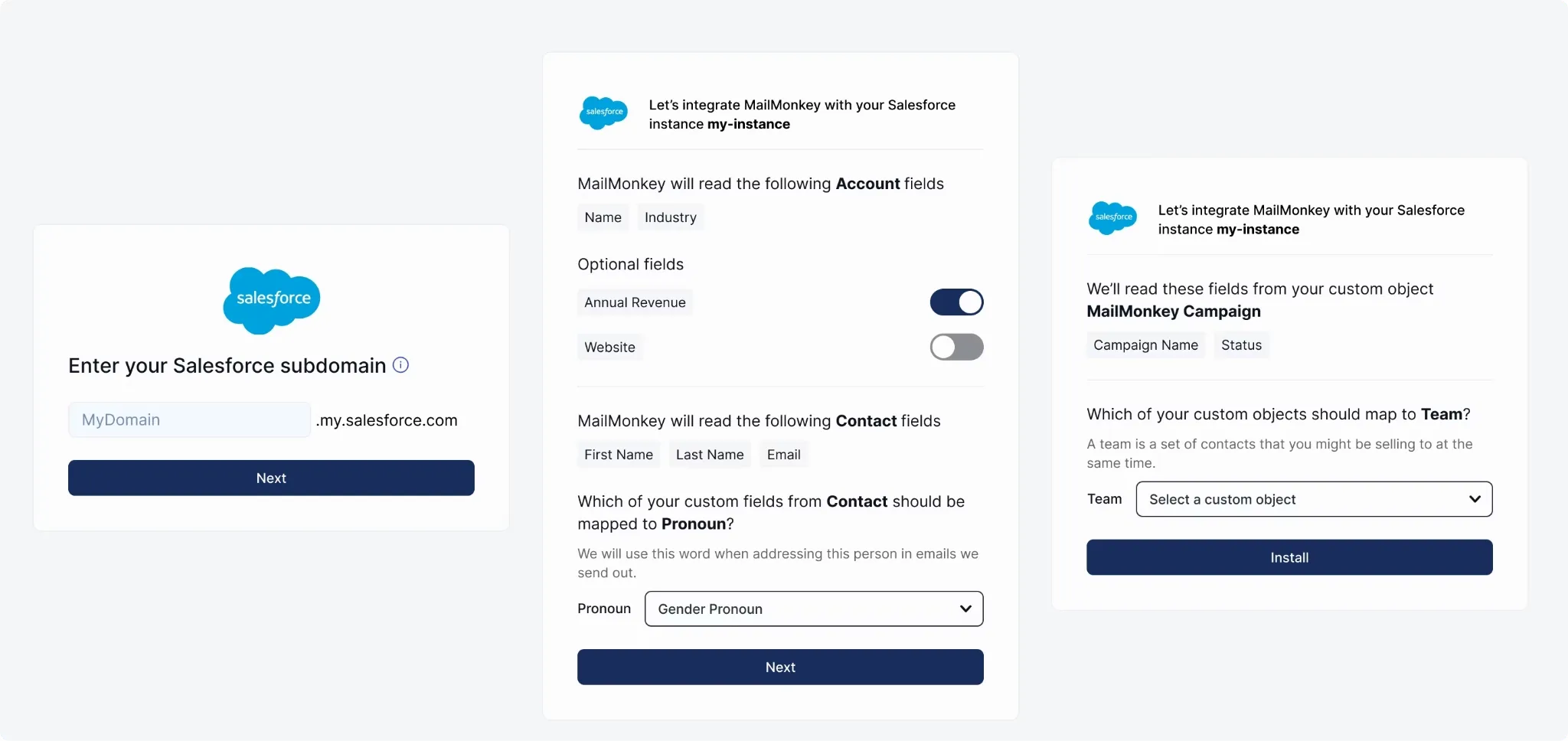
Best For: AI SDRs, revenue-intelligence tools, sales-analytics products, and conversation-intelligence layers that need deep, real-time connectors across many sales engagement tools, including the long tail.
Ampersand is customer-facing integration infrastructure for AI sales and RevTech products that need native access across the sales engagement stack. It ships live connectors for Outreach, Salesloft, Apollo, Gong, and cold-outbound tools like Lemlist, Instantly, Smartlead, and Outplay, and then gives teams a single framework for authentication, sync, webhooks, field mapping, agent access, and connector configuration.
Connector breadth across the sales engagement stack
Ampersand covers the sales engagement tools an AI product often has to support, including Outreach, Salesloft, Apollo, Gong, Calendly, Chili Piper, Drift, Lemlist, Instantly, Smartlead, Outplay, Mixmax, and Seismic. Teams define integrations through declarative configuration, so adding a cold outbound connector alongside a core sequencer does not require a separate integration service for each provider.
The live connector catalog spans the sales engagement, prospecting, scheduling, routing, marketing, and conversation intelligence categories. That breadth helps AI sales products onboard customers with different go-to-market stacks from the same integration framework.
Sub-second sequence and call events through Subscribe Actions
Ampersand’s Subscribe Actions deliver changes from customer tools through native webhooks, usually within a second of the source event. Ampersand also handles subscription setup, signature verification, retries, and rate-limit backoff, so teams do not have to rebuild webhook infrastructure for every provider.
For AI sales products, fast event delivery changes what the product can do during a live workflow. When a reply lands in Outreach, a call closes in Gong, or a prospect action triggers a routing update, the agent can act while the signal is still useful. 11x used Ampersand to cut its AI phone agent’s response time from 60 seconds to 5 seconds, enabling the agent to call prospects before they left the website.
Native fields across every connector
Ampersand mirrors each provider’s API, so tool-specific fields and objects stay available through the relevant connector. A custom Outreach field, a Salesloft cadence field, an Apollo prospecting field, or a Gong call disposition can still be used for scoring, routing, enrichment, and agent logic.
Custom fields and objects are available on every tier, so products can read a customer's own field setup instead of losing it to a generic schema. A product that depends on a customer’s own sequence taxonomy, call tags, routing fields, or enrichment fields can read those values directly from the connected source.
Per-customer field mapping through an embedded React component
Ampersand’s embedded React component lets each customer authenticate tools, choose fields, and map them to the product’s schema within the product UI. Each mapping is stored per tenant, so one customer can map Outreach fields one way while another maps Salesloft or Gong fields differently.
When a customer adds a new custom field or changes a mapping, they can update the configuration without creating an engineering ticket. For products onboarding many sales teams with different workflows, per-tenant mapping helps the integration scale with the customer base.
MCP server and AI SDK for agent access
Ampersand exposes sequence state, call data, reply events, and mapped fields to agents through its MCP server and AI SDK. The agent gets schema-aware tools tied to the customer’s connected providers, so it can read engagement context and write updates through the same integration layer.
This is useful for AI SDRs, outreach agents, revenue intelligence products, and conversation intelligence workflows. An agent can read Outreach sequence state, inspect Gong call data, update a status field, or use mapped customer fields without needing a separate tool surface for every provider.
Code-owned configuration with credential ownership
Ampersand stores integration logic in amp.yaml manifests that live in Git. Connector settings, sync behavior, field mappings, and related configuration can undergo pull-request review and ship via the team’s existing CI/CD workflow.
OAuth tokens remain under the product team’s control, with export support for future infrastructure changes, giving engineering teams greater control over authentication, customer connections, and long-term integration ownership.
Pros
- Live connectors across the core sales engagement stack and cold-outbound long tail, including Outreach, Salesloft, Apollo, Gong, Lemlist, Instantly, Smartlead, and Outplay.
- Sub-second sequence, call, and reply events through Subscribe Actions.
- Managed webhook infrastructure, including subscription setup, signature verification, retries, and rate-limit backoff.
- Native tool-specific fields and objects on every tier.
- Embedded React component for per-customer field mapping.
- MCP server and AI SDK for direct agent access.
- amp.yaml configuration in Git with CI/CD support.
- Customer-owned OAuth tokens with export support.
- One declarative framework for adding and maintaining many customer-facing connectors.
Cons
- Provider-specific data may require light modeling for teams that want one normalized schema.
- YAML configuration has a short ramp-up for teams used to visual builders.
Pricing: Free tier (2GB data, 5 customers, unlimited integrations). Catalyst plan at $999/month. Custom plans available for higher volumes. See pricing details.
2. Nango
Best For: Engineering teams that want open-source, self-hostable connectors and code-first control.
Nango provides an open-source integration layer with pre-built API connectors, managed authentication, token refresh, and a proxy for authenticated requests. Teams write integration logic as TypeScript functions and run it on Nango Cloud or their own infrastructure. It fits teams that want code-level control and have the engineering capacity to operate, maintain, and scale the integration layer.
Pros
- Open-source codebase with self-hosting support.
- Catalog of 800+ APIs with managed OAuth and token refresh.
- TypeScript functions for custom sync logic.
- MCP server available on paid tiers.
Cons
- Self-hosting requires the team to manage uptime, scaling, security patches, and connector maintenance.
- Embedded end-customer configuration is lighter than managed customer-facing setup flows.
Pricing: Free tier with 10 connections. The paid plan starts at $50/month. Custom enterprise pricing.
3. Merge
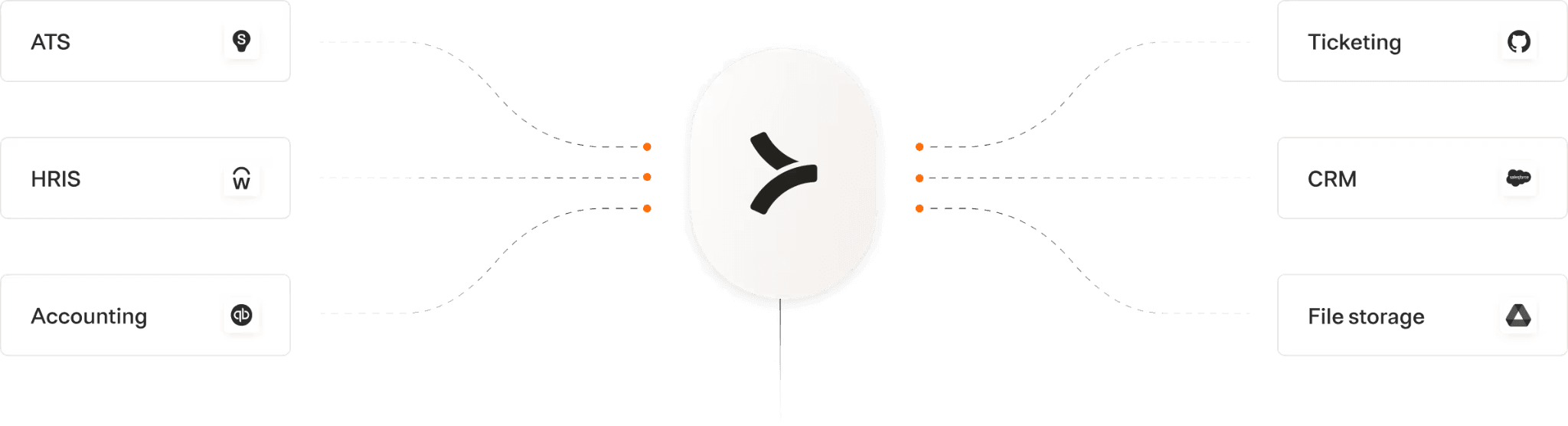
Best For: Products that need broad CRM-core coverage through one normalized schema.
Merge gives products a unified API across CRM, ATS, HRIS, and related categories. Its CRM coverage works well when a product mainly needs standard objects such as contacts, accounts, and deals across Salesforce, HubSpot, and Pipedrive. Sales-engagement-specific data, such as Outreach sequences, Salesloft cadences, Apollo prospecting data, and Gong call recordings, may be sparse or absent in the unified model, limiting use cases that depend on native engagement fields.
Pros
- Unified models across CRM and several adjacent categories.
- Broad coverage across Salesforce, HubSpot, and Pipedrive.
- Field Mapping for some custom data on supported plans.
- Merge Agent Handler for AI-agent access.
Cons
- Sales engagement tools such as Outreach, Salesloft, and Gong have limited coverage in the unified model.
- Common schemas can flatten tool-specific fields used by scoring, routing, and agent logic.
Pricing: Free for up to 3 production link accounts. Launch plan at $650 per month for 10 linked accounts, with additional per-account charges. Professional and Enterprise tiers require annual contracts.
4. Paragon
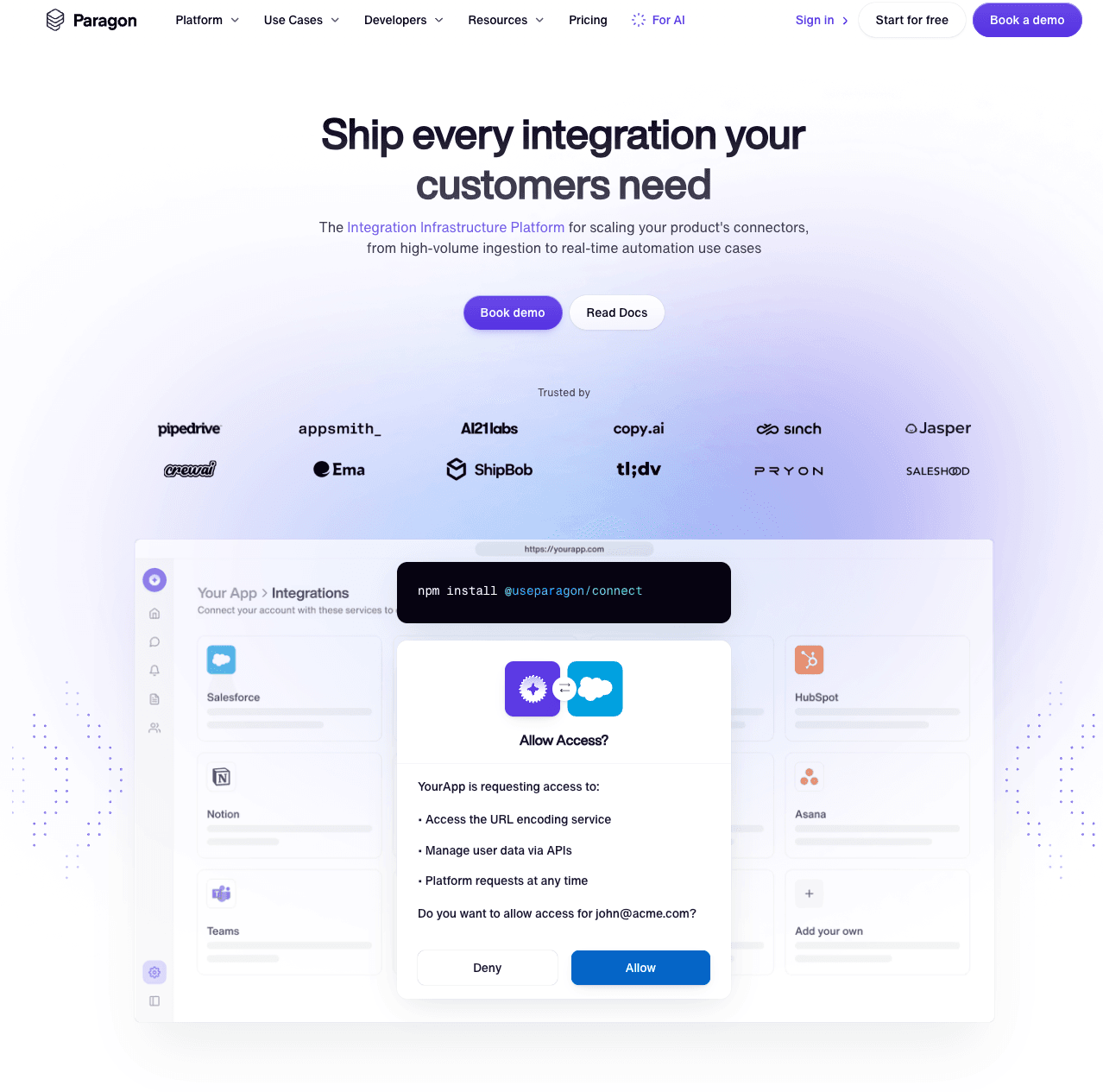
Best For: Teams that want to set up customer-facing integration through a visual workflow model.
Paragon combines a white-label Connect Portal, visual workflow builder, code-first SDK, and ActionKit for AI tool calling. It works for teams that want customer success, solutions, or end customers to help configure integration workflows while engineering keeps control through the SDK and GitHub sync. For sales engagement use cases, connector coverage is narrower, and workflow execution can introduce latency for agent actions that require live engagement signals.
Pros
- White-label Connect Portal for customer authentication and setup.
- Visual workflow builder with SDK support.
- ActionKit and MCP support for AI tool calling.
- GitHub sync for engineering-managed workflows.
Cons
- Workflow execution can add latency to agent-driven use cases.
- Sales engagement connector coverage is narrower than broader connector-framework options.
- Execution-based pricing can create cost variability as usage grows.
Pricing: A custom pricing model based on the number of connected users, with a free trial.
5. Apideck
Best For: Multi-vertical products that need lightweight unified CRM breadth alongside other categories.
Apideck offers unified APIs across CRM, ATS, accounting, HRIS, and other software categories. Its CRM API gives products a standardized surface for contacts, accounts, deals, and related records, with Vault handling authentication and connection management. It fits products that need broad, lightweight CRM access across several categories, but sales-engagement-specific connector depth is limited.
Pros
- Unified CRM API alongside accounting, HRIS, and other categories.
- Vault for authentication and connection management.
- Hosted MCP server across supported APIs.
Cons
- Sales engagement connector coverage is shallow.
- Unified models can flatten provider-specific sales engagement fields.
- AI sales workflows may need deeper native access than the CRM API provides.
Pricing: Launch at $599/month. Scale at $1299/month. Enterprise plans are custom. Free trial available.
Quick comparison: Sales engagement integration platforms in 2026
| Criteria | Ampersand | Nango | Merge | Paragon | Apideck |
|---|---|---|---|---|---|
| Sales engagement connector breadth | ✅ Core stack plus cold-outbound long tail, including Outreach, Salesloft, Apollo, Gong, Lemlist, Instantly, Smartlead, Outplay, Chili Piper, Calendly, Drift, Mixmax, and Seismic | ⚠️ Broad API catalog, with sales depth depending on the functions the team builds | ⚠️ Stronger fit for CRM-core objects than sales-engagement-specific objects | ⚠️ Workflow and ActionKit catalog, with sales engagement depth depending on connector and action coverage | ⚠️ CRM and adjacent categories, with lighter sales engagement depth |
| Real-time bi-directional sync | ✅ Sub-second Subscribe Actions, plus read/write sync into customer tools | ⚠️ Webhooks and sync framework, with latency depending on connector and implementation | ⚠️ Webhooks plus polling; sync frequency varies by category and plan | ⚠️ Managed Sync, workflow triggers, and synchronous ActionKit calls; real-time path depends on use case | ⚠️ Native and virtual webhooks; virtual webhooks rely on polling |
| Native fields and custom objects | ✅ Native provider fields, custom fields, and custom objects on every tier | ✅ Native API access through code-defined integrations | ⚠️ Common Models with supplemental data options; some advanced field access is plan-dependent | ⚠️ Workflow/action-level access; dynamic field mapping is plan-dependent | ⚠️ Unified models with custom field mapping on higher plans |
| Per-customer field mapping | ✅ Embedded React component with tenant-level mappings | ⚠️ Possible through code and configuration, but not a full embedded mapping flow | ⚠️ Field Mapping supports linked-account mappings on supported plans | ⚠️ Field mapping available, with advanced mapping gated by plan | ⚠️ Custom field mapping starts on Scale |
| Embedded customer setup UI | ✅ Embedded auth and field mapping inside the product | ⚠️ Auth-focused Connect UI; deeper setup stays more developer-led | ✅ Merge Link for customer authorization and setup | ✅ Connect Portal and Headless Connect Portal | ✅ Vault for customer authorization and connection management |
| AI-agent and MCP support | ✅ MCP server and AI SDK for direct agent access | ✅ MCP and tool-calling support | ✅ Merge Agent Handler for MCP-ready tool access | ✅ ActionKit and ActionKit MCP | ✅ Hosted MCP server and AI-oriented CLI |
| Code-first ergonomics | ✅ amp.yaml manifests in Git with CI/CD review | ✅ TypeScript functions in repo | ⚠️ API and SDK-first; normalized schema managed by Merge | ⚠️ Visual workflows with SDK and GitHub sync | ⚠️ Unified API and SDKs, with less connector logic owned in code |
| Credential ownership and portability | ✅ Product-owned OAuth tokens with import/export support | ✅ Credentials can stay under team control, especially self-hosted | ⚠️ Managed linked-account model | ⚠️ Managed credential layer | ⚠️ Vault-managed credentials |
| Starting point | ✅ Free to start with unlimited integrations | ✅ Free tier available | ✅ Free tier available | ⚠️ Limited free trial | ⚠️ Limited free trial |
Ready to ship deep, real-time sales engagement integrations for your AI product? Start building on Ampersand for free →
How to choose the right sales engagement integration platform
Start with the sales engagement tools your customers already use, then check how much your product depends on tool-specific sequence, call, and reply data.
Ampersand is the strongest fit for AI sales products that need deep, real-time connectors across the sales engagement stack, including the long tail. AI SDRs, revenue-intelligence tools, sales-analytics products, and conversation-intelligence layers should start here when they need sub-second events, native fields, per-customer mapping, and agent access through MCP.
Nango works for engineering teams that want open-source, self-hostable connectors and have the capacity to run the integration layer themselves.
Merge fits products whose integration needs remain close to CRM objects in Salesforce, HubSpot, and Pipedrive, where a normalized schema can quickly cover contacts, accounts, and deals.
Paragon is a good option for teams that want a customer-facing setup via a visual workflow model that customer success, solutions, or end customers can configure.
Apideck supports multi-vertical products, where sales engagement access is one category among several, and lightweight unified CRM coverage is sufficient.
Why Ampersand leads for AI sales products
AI sales products need engagement data that reflects each customer’s current sales workflow. Follow-up decisions depend on the reply state, sequence progress, call outcomes, mapped custom fields, and account-specific permissions, all of which can change while an agent decides what to do next. Ampersand leads here because it provides product teams with a customer-facing integration layer where each customer connects their own sales tools, maps their own fields, and grants agents approved access to fresh engagement context while preserving the native shape of the customer’s workflow.
Production value comes from faster agent action and less in-house integration maintenance. 11x used Subscribe Actions to reduce its AI phone agent response time from 60 seconds to 5 seconds, showing how event delivery speed affects live outreach. For AI SDRs, revenue-intelligence tools, and conversation-intelligence products, Ampersand reduces the engineering work behind OAuth, webhooks, tenant-level mapping, and agent access, so teams can spend more of the build cycle on sales product behavior and less on account-by-account connector upkeep.
Ready to ship deep, real-time sales engagement integrations for your AI product? Start building on Ampersand for free →
FAQs: Best sales engagement integration platforms in 2026
What is the difference between a sales engagement platform and a sales engagement integration platform?
A sales engagement platform helps a sales team run outreach, calls, replies, and follow-ups. A sales engagement integration platform sits inside a SaaS product and lets each customer connect the sales tools they already use. Ampersand handles the customer-facing connection layer, including authentication, sync, field mapping, and agent access, so the product can work across each customer’s stack.
Can my customers configure their own Outreach and Salesloft field mappings inside my product?
They can when the integration layer includes embedded customer configuration. Ampersand provides customers with an in-product setup flow to connect tools, select fields, and map them to the product’s schema. The in-product setup flow keeps field changes manageable after onboarding, especially when each sales team uses different sequence fields, tags, statuses, or routing rules.
Which platforms deliver sub-second Gong and Outreach webhooks for AI agents?
Ampersand is the strongest fit for sub-second sales engagement events because Subscribe Actions are designed for native webhook delivery. Fresh reply, call, and sequence context lets an agent decide on the next action using current information rather than a stale one. For more background on why polling creates delays in agent workflows, see Ampersand’s guide to real-time CRM events for AI agents.
Do these platforms cover newer tools like Lemlist, Instantly, and Smartlead?
Coverage varies by platform because newer outbound tools do not always fit cleanly into a shared sales engagement schema. Ampersand is a better fit when customers use a mix of established sequencers and newer outbound tools, because it can support provider-specific data without waiting for every tool to fit into a single normalized model.
How is a sales engagement integration platform different from Zapier or Workato?
Zapier and Workato are workflow automation tools for a company’s internal app stack. A sales engagement integration platform powers integrations inside a SaaS product, where each customer brings its own tools, credentials, permissions, and field setup. Ampersand supports the customer-facing product layer, with tenant-level configuration and agent access managed inside the product experience.