 Back to articles

Real-Time CRM Sync: Architecture, Webhooks, and Bidirectional Data Flow
Learn what real-time CRM sync actually requires, from webhooks and deduplication to bidirectional conflict resolution and production-grade event processing

Chris Lopez
Founding GTM
Real-Time CRM Sync: Architecture, Webhooks, and Bidirectional Data Flow
What Real-Time CRM Sync Actually Requires
Real-time CRM sync requires reliable event capture, delivery guarantees, idempotency, deduplication, conflict resolution, ordering, backfills, and observability. Switching from polling to webhooks helps reduce sync delay, but webhooks alone do not solve real-time CRM sync requirements. Bidirectional sync adds more risk because updates can originate in both your product and the CRM.
When your product records a meeting outcome or updates a lead score, the CRM needs to reflect those changes before the next sales rep takes action. A six-hour batch sync can make a warm lead go cold, and even a fifteen-second polling delay can leave an AI voice agent working with stale context during a live call. Production-grade real-time CRM sync depends on how the system handles duplicate events, conflicting writes, and recovery after outages.
Polling-Based CRM Sync vs. Event-Driven CRM Webhooks
Two models exist for propagating CRM data changes between systems, each supporting different latency, infrastructure, and product requirements.
Polling sends scheduled API requests to the CRM at fixed intervals and checks for records that have been modified since the last request. Engineering teams control request frequency, manage rate limits more easily, and avoid running a durable webhook ingestion layer. The downside is a fixed latency window. With a 60-second polling interval, changes can take up to 60 seconds to propagate. Polling also consumes API quota during quiet periods when no records have changed, which becomes expensive when Salesforce caps Enterprise Edition orgs at 100,000 daily API requests plus 1,000 per user license.
When polling is enough: Polling is suitable for internal analytics dashboards, nightly warehouse loads, batch reporting, and other workflows where minutes-long delays are acceptable. The main benefits are simpler infrastructure, lower cost, and more predictable failure modes.
Event-driven sync uses CRM webhooks to send changes when a record is updated. The CRM sends an HTTP POST when the change happens, and the receiving system can process the event within seconds. The cost is more infrastructure. Webhook handlers need to respond within strict time limits, validate signatures, and enqueue events for asynchronous processing. CRM webhooks also do not guarantee exactly-once delivery or event ordering, so deduplication and sequencing logic are required.
When event-driven sync is necessary: Event-driven sync is worth the added complexity when CRM freshness affects the end-user experience, an AI agent’s decisions, or the reliability of a customer-facing product.
Where Polling-Based CRM Sync Breaks Down
Polling works for batch-oriented workflows, but the use cases below require fresher CRM data than polling can reliably provide.
AI voice agents: A voice agent needs CRM context during a live call, including deal stage, contact ownership, recent activity, and custom field values. A 15 to 30-second polling delay leaves the agent speaking with stale or missing data during the call.
AI SDR and conversational AI: An AI SDR may need to read a contact’s current deal stage, generate a response, and write the outcome back to the CRM within the same interaction. Polling delays cause the system to act on outdated deal stages, owner assignments, or activity history, making the response feel disconnected from the account's actual state.
Customer-facing product dashboards: When live deal stages, contact records, and activity logs appear directly in the product, stale CRM data becomes visible to end users. If a customer sees an outdated deal stage long after the value in the CRM has changed, trust in the product drops quickly.
Real-time lead routing: Lead routing depends on current ownership and stage data to assign inbound leads to the right rep or queue. Polling delays mean routing decisions can be based on an outdated CRM state, sending leads to the wrong owner or workflow.
Core Architecture of Bidirectional CRM Sync
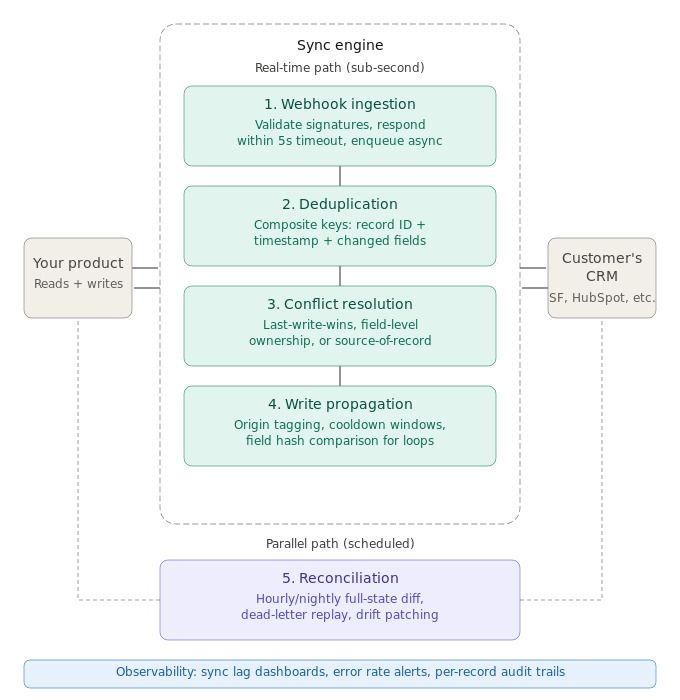
A production bidirectional CRM sync pipeline has four real-time processing layers, a scheduled reconciliation loop that runs in parallel, and an observability layer that spans the entire system. The diagram below shows how events flow between your product and a customer's CRM through each layer.
How Ampersand Powers Real-Time Bidirectional CRM Sync
Ampersand handles webhook ingestion, deduplication, conflict resolution, and reconciliation as managed infrastructure, letting engineering teams avoid a lengthy in-house build and ship a first integration in two to three weeks.
Sub-second webhook delivery
Ampersand’s Subscribe Actions deliver CRM events in under one second through event-driven infrastructure. When a record changes in Salesforce, HubSpot, or any of Ampersand’s supported CRMs, the event reaches the application without polling delays or cache layers. 11x used Ampersand’s webhook delivery to reduce CRM response times from 60 seconds to 5 seconds during live calls.
Managed bidirectional sync
Ampersand handles conflict resolution and loop prevention with its bidirectional sync engine. Engineering teams define integration behavior through declarative YAML manifests stored in Git and deployed through standard CI/CD pipelines. AI coding agents like Cursor and Claude Code can generate and update those YAML files, which makes Ampersand compatible with agentic development workflows.
Built for customer-facing product experiences
Every customer’s CRM has its own schema, objects, fields, and sync requirements. Ampersand supports custom objects and custom fields natively on all pricing tiers, and every plan includes per-customer field mappings. Embeddable React UI components let end customers configure authentication, field mappings, and sync preferences without engineering help.
Credential ownership with zero lock-in
Ampersand keeps OAuth tokens under the customer’s control and supports both token import and export. If the team later switches to another integration vendor, existing customers do not need to reconnect their CRM accounts or repeat the OAuth flow, reducing migration friction and avoiding unnecessary support requests.
Ampersand’s free tier includes 2 GB of data and support for up to 5 connected customers, with access to bidirectional sync, custom objects, custom fields, the field mapping UI library, and the AI SDK. Engineering teams can build a working integration, test webhook delivery against a live CRM, and validate the sync pipeline before moving to a paid plan. Start with Ampersand’s free tier →
FAQs About Real-Time CRM Sync
What is real-time CRM sync and how does it differ from batch sync?
Real-time CRM sync sends record changes between systems within seconds using event-driven mechanisms such as webhooks or Change Data Capture, whereas batch sync processes changes on a fixed schedule. Batch sync works well for internal reporting and warehouse loads, but if a sales rep, AI agent, or customer-facing dashboard could act on outdated CRM data between polling intervals, the sync needs to be event-driven. Ampersand's Subscribe Actions deliver webhook events in under one second, keeping your product current without requiring teams to build a custom ingestion layer.
What is bidirectional CRM sync and when do product teams need it?
Bidirectional CRM sync keeps your product and each customer's CRM consistent when both systems can create and modify records. In a unidirectional read-sync, data flows in one direction, and conflicts are impossible. Once the product writes data back, both systems become potential sources of truth for the same fields, and every write risks triggering an echo loop or overwriting a change the other system just made. Managing bidirectional writes safely requires conflict resolution policies, origin tagging, and cooldown logic for each customer's integration. Ampersand handles conflict resolution and loop prevention inside its sync engine across all pricing tiers, so product teams can enable write-back without building conflict resolution, origin tagging, and loop prevention from scratch.
Why do CRM webhooks need idempotency and deduplication logic?
CRM providers like HubSpot and Salesforce do not guarantee exactly-once webhook delivery. The same event can arrive multiple times, and event streams may arrive out of order. Without idempotency checks, a duplicate webhook can create duplicate records, double-count a metric, or trigger the same workflow twice. Engineering teams typically implement deduplication using composite keys that combine the record ID, timestamp, and changed fields, and maintain sequence tracking to process events in the correct order. Ampersand's sync engine includes deduplication, retry handling, and event ordering as managed infrastructure, which removes one of the most error-prone parts of a webhook-based integration.
When is polling-based CRM sync good enough?
Polling is the right choice when minutes or hours of latency won't degrade the user experience or produce incorrect automated decisions. Internal analytics dashboards, nightly data warehouse loads, and periodic reporting workflows all fall into this category, and the infrastructure remains simpler because failure modes are predictable and fixed intervals make API quotas easier to budget for. Event-driven sync becomes worth the added complexity when CRM data powers AI agents making real-time decisions, customer-facing features display live account data, or lead routing logic where a few seconds of stale ownership data can send leads to the wrong rep. Ampersand supports both polling and event-driven sync. Teams can start with polling for back-office workflows, then switch individual integrations to event-driven delivery through Subscribe Actions as latency requirements tighten.
What is the best platform for real-time bidirectional CRM sync?
For teams building AI agents, voice applications, or customer-facing products that depend on low-latency CRM data, Ampersand provides a fully managed sync pipeline. Webhook events arrive in under one second, bidirectional sync includes built-in conflict resolution and loop prevention, and every pricing tier supports custom objects and per-customer field mappings. Competitors typically gate both behind enterprise plans. Integration behavior is defined via declarative YAML stored in Git and deployed through standard CI/CD pipelines, keeping the sync logic version-controlled alongside the application code. Ampersand also provides full credential ownership through token import and export, so migrating away never requires customers to re-authenticate their CRM connections.