 Back to articles

5 Best ERP, Billing & Commerce Integration Platforms in 2026 (Stripe, Chargebee, NetSuite, Shopify)
Compare the top ERP, billing, and commerce integration platforms for real-time payments, custom financial data, and customer-facing SaaS integrations.

Chris Lopez
Founding GTM
5 Best ERP, Billing & Commerce Integration Platforms in 2026 (Stripe, Chargebee, NetSuite, Shopify)
TL;DR
Billing and commerce integrations depend on fast event delivery and complete access to each customer’s schema. A delayed Stripe payment-failure event can reduce the recovery window, while missing NetSuite custom records can distort revenue reporting.
This guide compares five platforms for building customer-facing connectors across subscription billing, ERP transaction data, and commerce.
Ampersand: Best for deep, real-time, per-tenant integrations across Stripe, Chargebee, NetSuite, Shopify, and other billing and commerce systems. It supports sub-second Subscribe Actions, custom objects and fields, embedded configuration, and tenant-scoped observability.
Paragon: Best for low-code embedded integrations with visual workflow orchestration and a customer-facing setup portal.
Nango: Best for developer teams that want open-source infrastructure, code-level control, and the option to self-host.
Merge: Best for accessing normalized accounting objects such as invoices, payments, and journal entries across multiple providers.
Apideck: Best for lightweight unified API coverage across standard accounting and ecommerce objects.
Why Billing and Commerce Integrations Are Unforgiving
Event delays affect revenue: A missed webhook in a marketing integration may delay a contact sync by an hour. In a billing workflow, the same failure can interrupt revenue recovery. When Stripe emits a payment-failure event and the connector drops it, the customer may never enter dunning, the invoice continues aging, and the resulting churn appears weeks later without a clear technical cause. Payment recovery platforms therefore depend on reliable event delivery because every delay reduces the time available for retries and dunning emails.
Commerce data must stay current: A late Shopify order event can cause an analytics product to report revenue that no longer matches the merchant’s admin dashboard. Delayed refund data can also trigger incorrect commission payments on revenue the business has already returned. These records drive reporting, fulfillment, and payouts, so synchronization delays quickly create financial discrepancies.
Customer schemas are rarely standard: Enterprise NetSuite accounts often contain custom record types, transaction columns, and saved searches shaped by years of finance processes. Chargebee and Recurly accounts may also include custom fields on subscriptions, customers, and invoices. Integration layers that expose only standard objects can omit the data required for revenue recognition, usage-based billing, or commission calculations.
Each tenant needs its own configuration: A reliable billing and commerce integration requires fast bi-directional event delivery, complete read and write access to custom objects and fields, and a separate configuration for every customer account. Since schemas, field mappings, and billing setups vary by tenant, the connector must accommodate these differences without requiring a separate integration build for each customer.
How We Evaluated Billing and Commerce Integration Platforms
We assessed each platform against the capabilities that determine whether a billing or commerce integration can support production workloads.
Coverage across billing, ERP, and commerce: Revenue products often connect to several systems at once. We checked for production-ready integrations with subscription billing providers such as Stripe, Chargebee, Recurly, Zuora, and Paddle, as well as ERP and commerce systems including NetSuite, Shopify, and Square. Limited coverage can force teams to maintain a second integration layer for unsupported systems.
Real-time webhook delivery: We reviewed whether source events reach the product through immediate push delivery or scheduled polling. Payment failures, refunds, order updates, and fulfillment events lose value with every minute of delay, so we weighted push delivery over polling.
Custom object and field support: We examined whether each platform can read and write custom objects and fields through its standard interface. This includes NetSuite custom record types and transaction columns, as well as custom fields in billing systems such as Chargebee. Platforms that rely on passthrough endpoints leave more parsing and maintenance work to the engineering team.
Per-tenant configuration and observability: Every customer can use a different schema, mapping, and account setup. We looked for customer-specific field mappings, sync settings, logs, retries, and configuration that can be managed without hard-coding each tenant’s requirements into the application.
AI-agent readiness: We also checked whether agents can query connected billing and commerce data through an MCP server or a comparable interface. The strongest implementations preserve each customer’s permissions while exposing live, structured records to the agent.
The 5 Best ERP, Billing & Commerce Integration Platforms in 2026
1. Ampersand
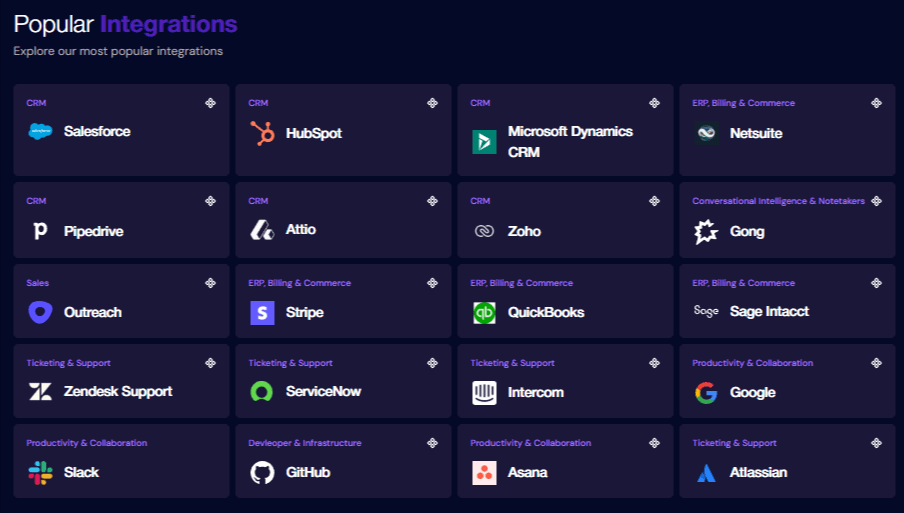
Ampersand provides the integration infrastructure for building customer-facing connections to billing, ERP, and commerce systems. Ampersand integrations include Stripe, Chargebee, NetSuite, Shopify, Recurly, Zuora, Paddle, Square, QuickBooks, and other finance systems used across revenue recognition, payment recovery, commission, and commerce products. These connectors can combine historical backfills, scheduled and on-demand reads and writes, authenticated proxy requests, and real-time subscriptions within a single integration architecture.
For event-driven use cases, Subscribe Actions deliver supported creates, updates, and deletions to your application through webhooks in under a second. Events include the provider fields, mapped field names, event type, and timestamp, while replay and backfill support help restore continuity after outages or during customer onboarding. Write Actions handle updates in the opposite direction, giving products separate primitives for receiving source events and writing data back.
Ampersand also preserves the structure of each customer account. Its schema and metadata APIs expose the objects and fields available for a specific connection, including custom objects and custom fields, while embedded mapping components let customers align their own schema with the product’s data model. The native NetSuite integration supports reads and writes through the REST API, read access through SuiteQL, managed authentication, field mapping, rate-limit handling, and detailed operational logs.
Integration behavior is defined in declarative YAML manifests and deployed through the Ampersand CLI, so connector changes can move through source control, code review, and CI/CD. The managed server keeps each customer’s connection, configuration, credentials, mappings, and sync state separate, while handling token refresh, retries, error parsing, rate limits, and backfills.
Customer-facing setup can run through prebuilt React components or a headless UI library. End users authenticate their accounts, select objects and fields, and manage mappings from inside the SaaS product. The dashboard provides customer-level sync operations and logs for troubleshooting, while customer-specific ERP query support addresses products that need to read customized finance data beyond a fixed accounting schema.
Ampersand also includes an AI SDK and MCP server, allowing agents to access connected systems through tenant-scoped tools while retaining each customer’s authentication and integration configuration.
Best For
Product and engineering teams building revenue recognition, usage-based billing, payment recovery, commission, or commerce analytics products that require bidirectional data access, customer-specific schemas, embedded setup, and real-time event processing across multiple billing and ERP systems.
Pros
- Deep billing, ERP, and commerce coverage: Connectors include Stripe, Chargebee, NetSuite, Shopify, Recurly, Zuora, Paddle, Square, and QuickBooks.
- Real-time event delivery: Subscribe Actions send supported source-system changes to webhook destinations in under a second.
- Bi-directional integration actions: Read, Write, Subscribe, and Proxy Actions cover backfills, incremental syncs, events, updates, and authenticated API requests.
- Custom objects and fields: Customer-specific schemas can be inspected, mapped, read, and written without reducing every account to a fixed unified model.
- Declarative integration management: YAML manifests, the CLI, source control, and CI/CD keep connector definitions reviewable and versioned.
- Embedded customer configuration: React components and the headless UI library support authentication, object selection, field selection, and mapping inside the product.
- Managed operations: Ampersand handles credentials, token refresh, retries, error parsing, rate limits, backfills, and detailed sync logs.
- AI-agent access: The AI SDK and MCP server expose connected customer systems to agents through scoped tools.
Cons
- Some niche systems may require a custom connector that the team can build for your use case.
- YAML-based configuration is best suited to engineering-led teams.
Pricing: Free tier (2GB data, 5 customers, unlimited integrations). Catalyst plan at $999/month. Custom plans available for higher volumes. See pricing details.
2. Paragon
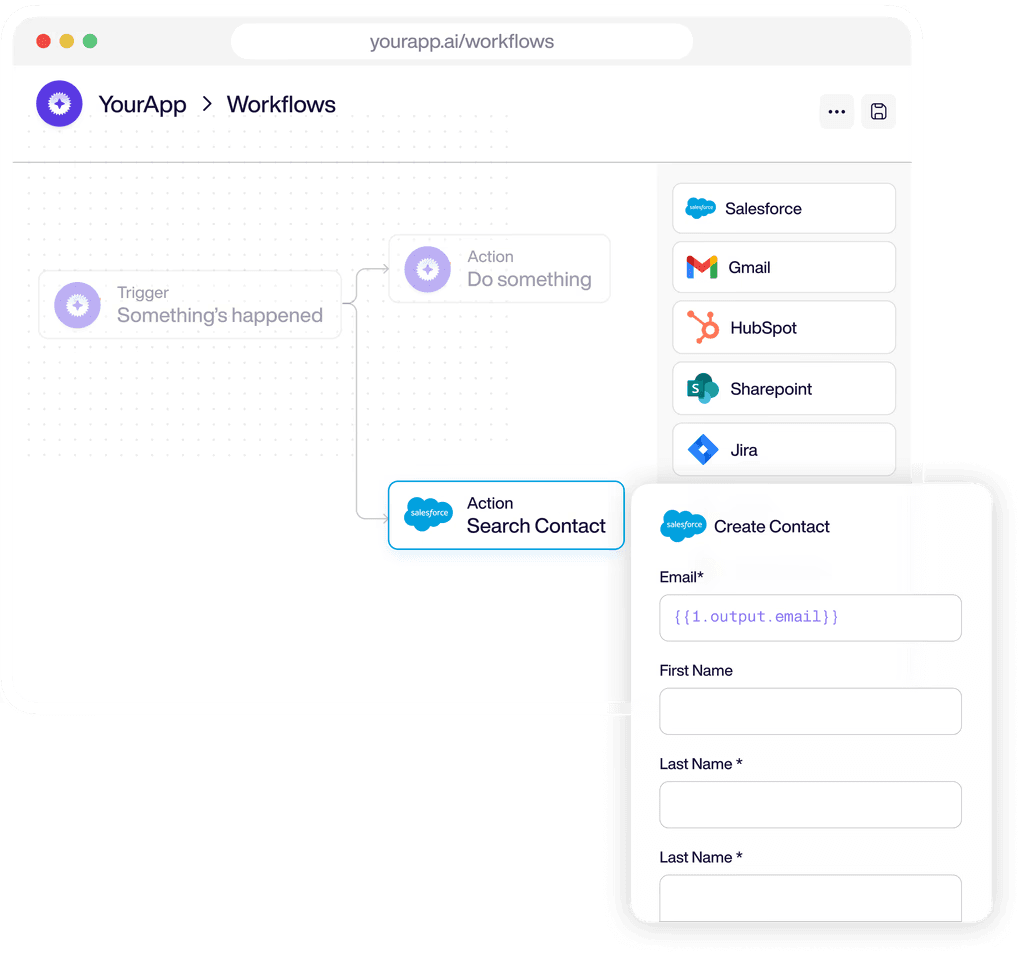
Paragon combines managed authentication, an embeddable Connect Portal, and workflow tooling for customer-facing integrations. Its catalog includes Stripe, NetSuite, and Shopify, while integration logic can be created through a low-code editor or TypeScript. Paragon also offers managed syncs and synchronous actions, although deeper field mapping and deployment options depend on the plan.
Best For
SaaS teams that prefer visual workflow development and an embedded customer setup experience.
Pros
- Embeddable Connect Portal for authentication and configuration.
- Visual workflow builder for common integration logic.
- Managed authentication and automatic retries.
- TypeScript support for custom workflows.
Cons
- Advanced configuration may require TypeScript.
- Dynamic field mapping is limited to Enterprise.
Pricing: A custom pricing model based on the number of connected users, with a free trial.
3. Nango
Nango is an open-source integration runtime that supports more than 800 APIs. Developers write provider-specific functions in TypeScript, while Nango handles authentication, credentials, retries, rate limits, execution, logs, and tenant isolation. Integrations can run on Nango Cloud, with full self-hosted deployment available to Enterprise customers.
Best For
Developer teams that want to own their integration code and retain the option to self-host.
Pros
- Open-source integration runtime.
- Support for more than 800 APIs.
- TypeScript functions stored and reviewed as code.
- Managed retries, rate limits, logs, and credentials.
Cons
- Integrations require TypeScript development.
- Full self-hosting requires an Enterprise plan.
Pricing: Free tier with 10 connections. The paid plan starts at $50/month. Custom enterprise pricing.
4. Merge
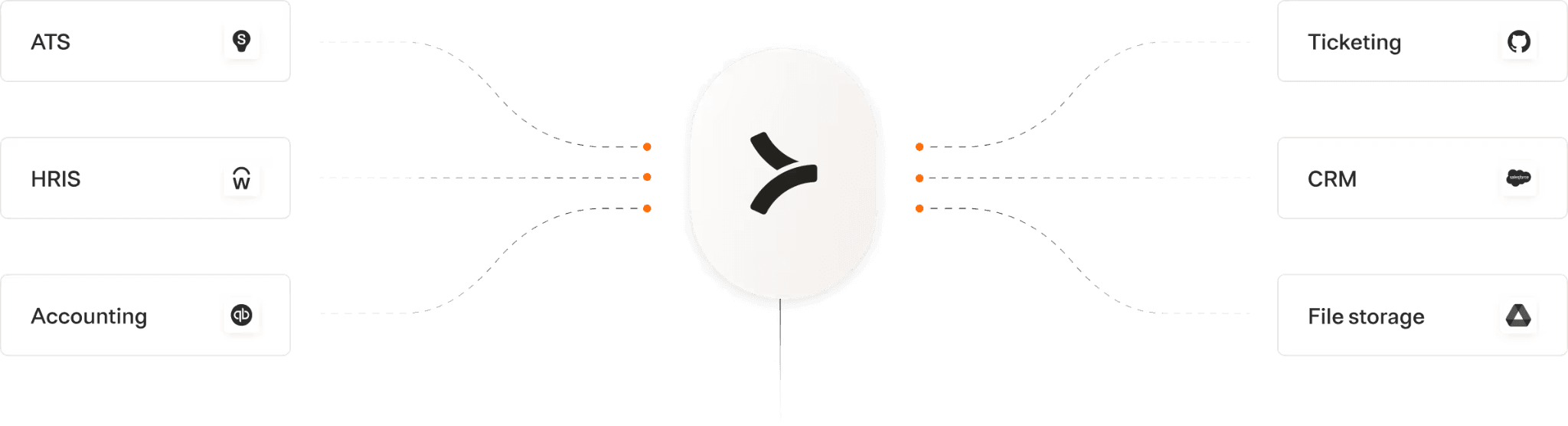
Merge provides a unified Accounting API with normalized models for records such as invoices, payments, journal entries, expenses, and transactions. It supports providers including NetSuite, QuickBooks, Xero, and Sage Intacct, while Merge Link handles customer authentication. Field Mapping, Remote Data, and Authenticated Passthrough extend access beyond the standard common models.
Best For
Teams that need consistent accounting records across several providers and can work mainly within normalized models.
Pros
- Normalized accounting objects across supported providers.
- Read and write access through one Accounting API.
- Embedded account connection through Merge Link.
- Passthrough and remote data access for provider-specific requirements.
Cons
- Subscription billing and e-commerce records fall outside the scope of the Accounting API.
- NetSuite freshness depends on the configured sync plan or additional webhook handling.
Pricing: Free for up to 3 production link accounts. Launch plan at $650 per month for 10 linked accounts, with additional per-account charges. Professional and Enterprise tiers require annual contracts.
5. Apideck
Apideck offers unified APIs across accounting, ecommerce, ERP, and other software categories. Its APIs use normalized models while retrieving records directly from connected providers. Vault handles customer authentication and connection settings, and the Proxy API covers provider endpoints outside the unified models.
Best For
Teams that need unified access to standard accounting and ecommerce records across multiple providers.
Pros
- Unified Accounting and Ecommerce APIs.
- Direct access to current provider data.
- Embedded authentication through Vault.
- Proxy access for endpoints outside the unified models.
Cons
- No dedicated unified API for subscription billing lifecycles.
- Custom field mapping starts on the Scale plan.
Pricing: Launch at $599/month. Scale at $1299/month. Enterprise plans are custom. Free trial available.
Comparison Table: Billing and Commerce Integration Platforms (2026)
| Platform | Billing & commerce coverage | Sub-second webhooks | Custom object depth | Per-tenant configuration | Embedded customer UI | AI agent (MCP) |
|---|---|---|---|---|---|---|
| Ampersand | ✅ Deep native coverage across Stripe, Chargebee, NetSuite, Shopify, Recurly, Zuora, Paddle, Square, QuickBooks, and other ERP and billing systems | ✅ Subscribe Actions deliver supported events in under a second through event-driven push delivery | ✅ Reads, writes, and maps standard and custom objects and fields without reducing them to a fixed common model | ✅ Declarative YAML manifests plus customer-specific schemas, object selections, field mappings, and connection settings | ✅ Embeddable React components and Headless UI for authentication, configuration, object selection, and field mapping | ✅ AI SDK and multi-tenant MCP server with customer-scoped credentials and mappings; MCP is currently in alpha |
| Paragon | ✅ Stripe, NetSuite, Shopify, and a broader SaaS connector catalog | ⚠️ Real-time webhook triggers for supported providers, without a platform-wide sub-second commitment | ⚠️ Field Mapping and direct API requests support provider-specific data through workflow or code logic | ✅ Per-user settings and field mappings through Connect Portal | ✅ Connect Portal and Headless Connect Portal | ✅ ActionKit MCP server for prebuilt integration actions |
| Nango | ✅ More than 800 APIs, with integrations implemented and customized in TypeScript | ⚠️ External webhooks can trigger real-time processing; scheduled syncs are used where provider webhooks are unavailable | ⚠️ Custom objects and fields are accessible through provider-specific API logic written by the engineering team | ✅ Connection-scoped credentials, metadata, and per-customer function behavior | ⚠️ Connect UI handles authorization; deeper field selection and mapping require custom implementation | ✅ Functions can be exposed through Nango’s MCP server |
| Merge | ⚠️ Unified Accounting covers NetSuite and standard ledger records; subscription billing lifecycles and ecommerce orders sit outside this API | ❌ Uses configurable synchronization frequencies, without a general sub-second event layer | ⚠️ Remote Fields and Field Mapping extend common models; unsupported objects require passthrough requests | ⚠️ Linked-account scopes and mappings within normalized common models | ✅ Embedded Merge Link component | ⚠️ Agent Handler supports MCP as a separate product from Merge Unified |
| Apideck | ⚠️ Unified Accounting and Ecommerce APIs, without a dedicated subscription billing lifecycle API | ⚠️ Native webhooks where available; Virtual Webhooks use polling for providers without native events | ⚠️ Custom Field Mapping starts on Scale, with provider-specific endpoints available through Proxy | ⚠️ Per-consumer Vault connections; custom field mapping is plan-dependent | ✅ Customizable Vault interface; full white-labeling requires Enterprise | ✅ MCP server with tools across its Unified APIs; currently in beta |
Ready to ship real-time ERP, billing and commerce connectors? Start free with Ampersand →
How to Choose a Billing and Commerce Integration Platform
Ampersand is the strongest choice when your product reads and writes customized billing or ERP data across many tenants and a delayed event carries a revenue cost.
Paragon fits teams that want to assemble integration logic in a visual editor and hand customers a hosted setup portal.
Nango makes sense if your engineers want to own the provider-specific TypeScript and keep a self-hosting path open.
Merge covers products whose reads stay within normalized accounting objects such as invoices, payments, expenses, and journal entries.
Apideck works when standard accounting and ecommerce records satisfy the product and the Proxy API can absorb the occasional provider-specific call.
Also Read:
Best usage-based billing platforms
Best ERP integration platforms
Why Ampersand Is the Best Billing and Commerce Integration Platform
Billing, ERP, and commerce integrations must preserve the speed, schema, and configuration of every customer system. Ampersand combines real-time Subscribe Actions, bi-directional data access, custom object support, per-tenant mappings, embedded configuration, and Git-managed integration definitions into a single engineering workflow, which suits products where a delayed event becomes lost recovery revenue or an incomplete record becomes a misstated report.
Teams including Crunchbase, 11x, and Clarify use Ampersand for customer-facing integrations in production. 11x reduced its AI phone agent’s response time from 60 seconds to 5 seconds after switching to Ampersand.
Start building billing and commerce integrations with Ampersand for free →
FAQs: Best ERP, Billing & Commerce Integration Platforms in 2026
How do I build a Stripe API integration for a B2B SaaS product?
Treat every customer account as a separate tenant with isolated credentials, permissions, sync state, and error logs. The connector should validate webhook signatures, process events idempotently, retry failed requests, and run periodic reconciliation for events that may have been missed. Ampersand’s Stripe integration supports Read, Write, and Proxy Actions across payments, invoices, subscriptions, customers, refunds, and other Stripe objects.
Which integration platforms support bi-directional integration with both Stripe and Chargebee?
Ampersand and Nango can both support reads and writes across Stripe and Chargebee. Ampersand provides managed Stripe and Chargebee connectors with Read, Write, and Proxy Actions. Nango handles authentication and execution infrastructure for both APIs, while the provider-specific read and write logic remains in the team’s TypeScript code. Ampersand requires less build work for teams that do not want to code each operation themselves.
How do I handle NetSuite custom record types without passthrough workarounds?
The integration must discover the records and fields available in each customer’s NetSuite account and store that schema with the tenant’s configuration. Ampersand handles the discovery step through its object metadata APIs, and embedded mapping components let each customer align custom record types and transaction columns with the product's data model, so no account needs separate parsing logic.
What is the difference between a billing integration platform and subscription billing software?
Subscription billing software manages a company’s plans, usage, invoices, renewals, payments, and revenue operations. A billing integration platform connects a SaaS product to its customers' billing systems. Chargebee and Recurly belong to the first category, while Ampersand provides the authentication, data access, mappings, and sync infrastructure needed to connect those systems to another product.
Can my customers configure their own NetSuite field mappings inside my product?
Ampersand’s InstallIntegration React component lets customers connect their NetSuite account and configure read and write objects, required and optional fields, and object and field mappings directly in the product. Each configuration is associated with the customer’s group, which keeps credentials and mapping choices separated across tenant accounts.
How do AI agents query live billing data?
An agent queries billing data by calling structured MCP tools that execute with the connected customer’s credentials and configuration. Ampersand’s MCP server scopes access by project, integration, and customer group, then exposes the same integration tools available through its AI SDK across more than 150 connectors.