 Back to articles

The 5 Best Conversational Intelligence Integration Platforms in 2026 (Gong, Chorus, Fireflies, Otter)
Compare the top conversational intelligence integration platforms for AI products, including Gong, Chorus, Fireflies, and Zoom integrations.

Chris Lopez
Founding GTM
The 5 Best Conversational Intelligence Integration Platforms in 2026 (Gong, Chorus, Fireflies, Otter)
TL;DR
An hour of sales calls can produce diarized transcripts, tracker matches, topic segments, talk-time metrics, and deal signals across each customer’s Gong, Chorus, Fireflies, or Zoom account. A customer-facing revenue AI product must process that volume soon after every call while keeping hundreds of customer connections authenticated and isolated. The integration layer therefore needs to sustain heavy transcript ingestion, deliver call events with minimal delay, and manage OAuth separately for every tenant. Connector coverage becomes useful only when the underlying requirements are also handled reliably.
This guide compares five platforms for teams building customer-facing conversational intelligence integrations.
Ampersand: Best suited to revenue AI products that need provider-native Gong, Chorus, Fireflies, and Zoom connectors, sub-second event delivery through Subscribe Actions, managed per-tenant OAuth, embedded setup components, connection-level observability, and MCP access for downstream agents.
Paragon: Best for teams that want customers or low-code operators to configure integrations through a white-label portal and visual workflow builder.
Nango: Best fit for engineering teams that want source-available connectors and direct control over sync logic, infrastructure, and deployment.
Merge: Best for products whose requirements fit normalized data models and scheduled synchronization across supported software categories.
Unified: Best suited to products that need unified API and MCP access across Gong, Fireflies, Zoom, and related call tools.
Why conversational intelligence integrations are different
Conversational intelligence integrations place simultaneous pressure on data volume, delivery speed, and tenant isolation. CRM integrations typically handle structured records, while billing integrations focus on accuracy and reconciliation. Call data introduces larger payloads, time-sensitive signals, and a separate authentication lifecycle for every customer account. The three challenges below can expose weaknesses in architectures that perform well for lighter integration categories.
Transcript volume dwarfs CRM record volume
A single rep can generate three to five hours of audio during a normal calling day. Gong can convert those calls into diarized transcripts, tracker matches, topic segments, and talk-time metrics. Across a 40-rep sales team, that creates a steady flow of large payloads before the rest of the customer base is included. Polling infrastructure designed for contacts or deal records can begin timing out or exhausting rate limits during peak calling hours, when transcript queues are already at their busiest.
Revenue AI needs deal signals as calls end
Coaching alerts, deal-risk scores, and AI SDR follow-ups lose value when the underlying transcript arrives too late. On a 15-minute polling cycle, the prospect may have left the site, and the rep may already be in another meeting before the product receives the call data.
Push-based delivery is already available directly from the providers. Gong admins can configure automation rules that send a webhook after a call finishes processing, while Fireflies can notify subscribers through its GraphQL API. The product still has to receive those events for every customer tenant, verify signatures, manage subscriptions, retry failed deliveries, and absorb sudden increases in transcript traffic.
Every customer brings their own Gong or Chorus tenant
An internal workflow authenticates with one Gong account. A customer-facing product authenticates each customer separately, so a base of 300 accounts creates 300 OAuth grants with different scopes, refresh schedules, and administrators. Credentials can expire or be rotated without warning, leaving an agent without the call context it needs. Reliable tenant-level authentication requires each grant to be refreshed, revoked, and monitored independently as the customer base grows.
How we evaluated conversational intelligence integration platforms
Our scoring reflects the needs of a product team aiming to ship customer-facing conversational intelligence connectors within four to eight weeks. Use the criteria below to assess how well each option can support production workloads across multiple customer tenants.
CI-app coverage: Existing connectors for Gong, Chorus, Fireflies, and Zoom determine the number of customers that can be onboarded without additional development. We also considered support for adjacent tools such as Otter, Avoma, and Fathom.
Real-time event delivery at transcript volume: Native webhook support is only useful when the integration layer can also manage retries, queueing, and rate-limit backoff during peak calling periods. Higher scores went to platforms that can deliver call events within seconds without allowing transcript traffic to overwhelm the sync pipeline.
Per-tenant OAuth management: Each customer account requires its own authentication grant, refresh cycle, and revocation path. We assessed how much of that lifecycle the platform manages and whether your team retains ownership of the underlying tokens.
Embedded customer-facing setup: Customer admins should be able to connect their conversational intelligence account and configure data sync from within your product. Platforms received stronger scores when setup could be completed without support or engineering involvement.
AI-agent and MCP readiness: Agents need schema-aware access to calls, transcripts, and provider-specific fields while remaining scoped to the correct customer tenant. We evaluated the availability of MCP servers, SDKs, and agent-facing actions.
Event speed and tenant-level authentication receive the greatest weight because delayed transcripts and failed credentials directly affect the product experience.
5 best conversational intelligence integration platforms in 2026
1. Ampersand
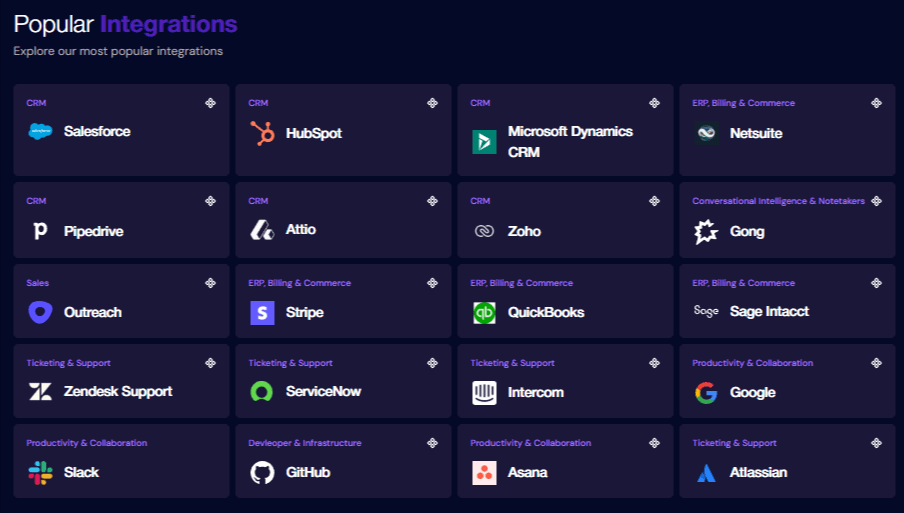
Best for: AI SDRs, sales coaching tools, revenue intelligence products, and meeting analytics SaaS that need customer-specific access to conversation data.
Ampersand provides product teams with a single framework for building and managing integrations with their customers’ conversational intelligence tools. Its Gong, Chorus, Fireflies, and Zoom integrations come with managed authentication, sync infrastructure, field mapping, customer setup components, operational logs, and tools for AI agents.
Live connectors for Gong, Chorus, Fireflies, and Zoom
Ampersand works with each provider’s API objects and fields, including custom fields where the provider supports them. Teams can use Read Actions to pull records, Write Actions to send data back, Subscribe Actions to receive events, and Proxy Actions to access other provider endpoints.
Integration settings are defined in amp.yaml, so teams can review and deploy connector changes via Git. Ampersand integrations also include Avoma, Clari Copilot, Fathom, Granola, Four/Four, and Jump, along with connectors across CRM, sales, marketing, support, billing, and productivity tools.
Sub-second call events through Subscribe Actions
Subscribe Actions manage webhook authentication, event delivery, retries, rate limits, and replay history. Once a supported provider emits an event, Ampersand can forward it to the product endpoint in under a second.
Provider processing time still affects the full delivery window. Gong sends its call.created webhook after the call has finished processing and appears in the Gong call library, which can take several hours. Ampersand then receives and forwards the event without requiring the product team to maintain separate webhook infrastructure for every customer.
After adopting Subscribe Actions for Salesforce and HubSpot updates, 11x cut its AI phone agent's speed-to-lead time from 60 seconds to 5 seconds.
Managed per-tenant OAuth with token ownership
Ampersand manages authentication separately for every customer connection, including secure token storage, refreshes, retries, pagination, and provider rate limits. Teams can also import existing tokens or export them later, which keeps the credentials under their control.
Embedded React components for customer self-serve setup
Ampersand provides prebuilt React components for connection setup, object selection, and field mapping. Its Headless UI offers the same installation and configuration controls with more freedom over the product’s design.
Customers can connect their own Gong, Chorus, Fireflies, or Zoom account, choose which data to sync, map fields, and natively repair expired connections.
Per-customer observability
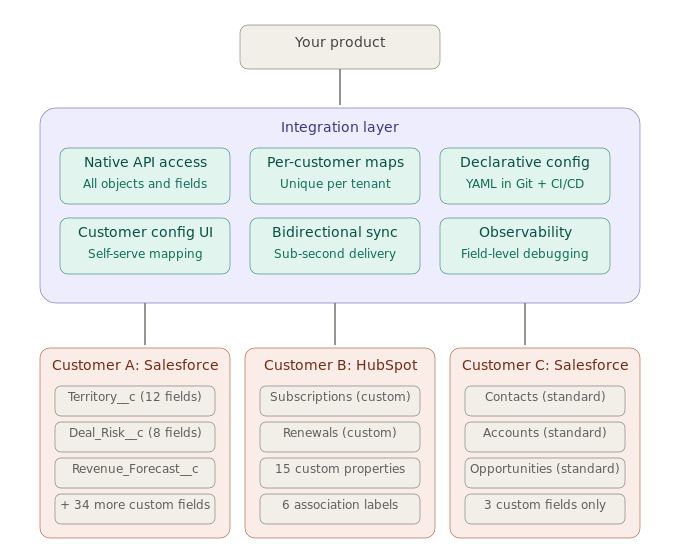
The dashboard keeps detailed logs for each customer installation. Engineering and support teams can inspect reads, writes, webhook deliveries, authentication failures, rate-limit responses, and API errors for one customer without searching through a shared integration service.
MCP server and AI SDK for the agents consuming call data
Ampersand’s AI SDK and MCP server expose connected providers as tools that agents can call. Agents can read records, make authenticated provider requests, create or update records, check connection status, and start OAuth flows.
Each request uses the correct customer credentials, permissions, and field mappings. Ampersand applies the same token refresh and rate-limit handling before returning data to the agent.
Pros
- Ready-made connectors for Gong, Chorus, Fireflies, Zoom, and other conversation tools
- Support for provider-specific objects, custom fields, reads, writes, subscriptions, and proxy requests
- Git-reviewed configuration through amp.yaml
- Managed authentication with token import and export
- Prebuilt and headless React components
- Retries, rate-limit handling, pagination, and API version management
- Detailed logs for each customer installation
- AI SDK and MCP access for customer-scoped agents
- Unlimited integrations across all plans
Cons
- Some provider connections require an admin to complete setup in the source app
- Teams new to configuration-as-code may need time to learn amp.yaml
Pricing: Free tier (2GB data, 5 customers, unlimited integrations). Catalyst plan at $999/month. Custom plans available for higher volumes. See pricing details.
Also read our guide on building AI agents with Gong.
2. Paragon
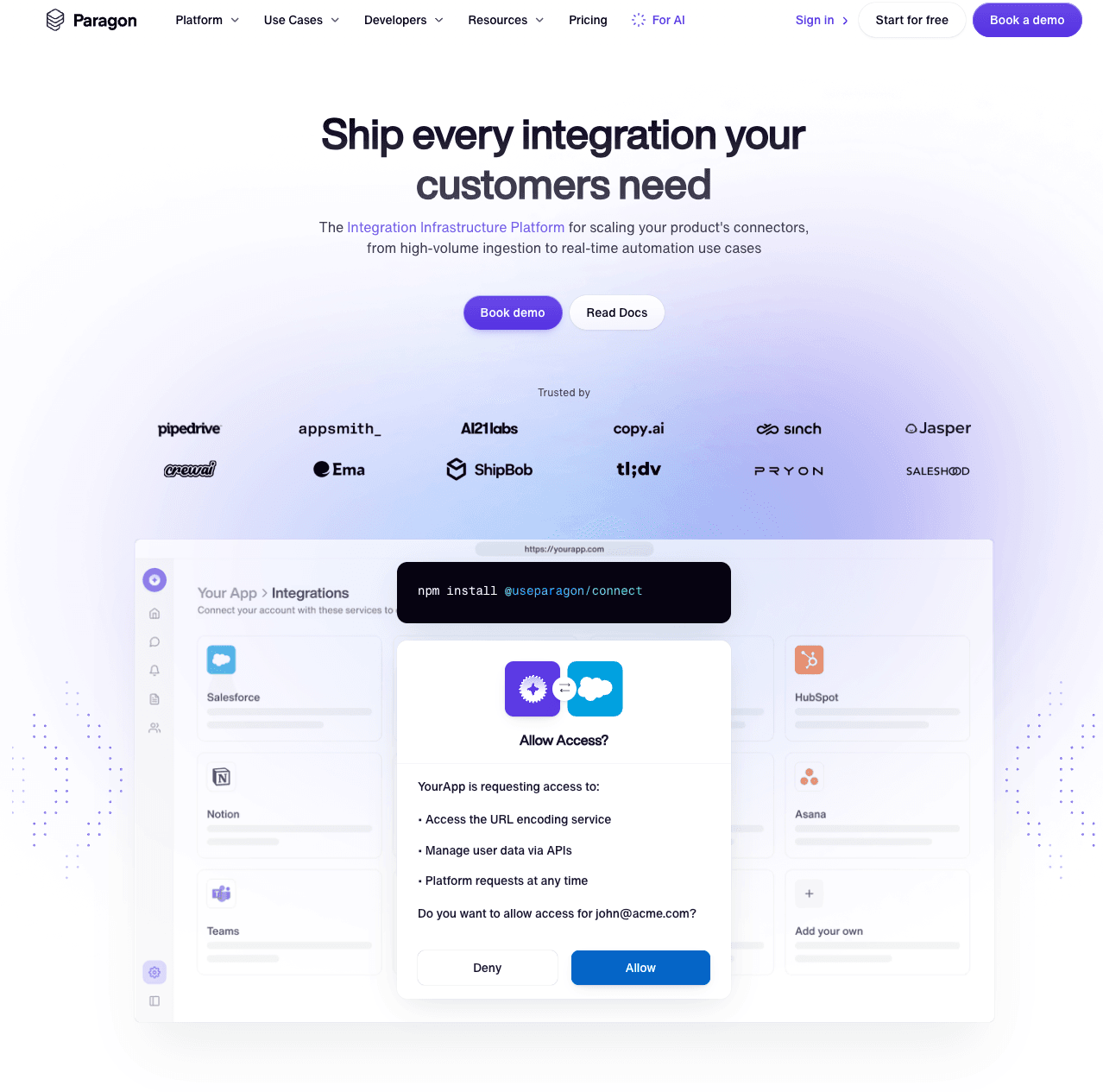
Best for: Teams that want customers or low-code users to configure integrations through an embedded portal.
Paragon combines its Connect Portal with Managed Sync, Workflows, and ActionKit. Customer admins can connect their accounts through a white-label or headless setup flow. Teams can write integration logic in TypeScript or use the low-code editor, while Managed Sync supports data ingestion as often as once per minute. ActionKit provides synchronous API and MCP actions for AI agents.
Pros
- White-label and headless customer setup
- TypeScript and low-code workflow options
- ActionKit API and MCP support
Cons
- The shortest Managed Sync interval is one minute
- Pricing requires a custom quote
Pricing: A custom pricing model based on the number of connected users, with a free trial.
3. Nango
Best for: Engineering teams that want code-owned integrations and control over provider-specific logic.
Nango takes an open-source, code-first approach to integrations. Its catalog covers more than 800 APIs, and its Gong connector supports both Basic Auth and OAuth. Syncs, actions, and webhook handlers can be written as TypeScript functions kept in the team’s repository. Nango manages credentials, retries, rate limits, logs, and MCP tool calls, while full self-hosting is available to Enterprise customers.
Pros
- Broad API catalog with managed authentication
- TypeScript functions kept in source control
- Support for syncs, webhooks, and MCP tools
Cons
- Custom transcript flows may require provider-specific code
- Full self-hosting requires an Enterprise plan
Pricing: Free tier with 10 connections. The paid plan starts at $50/month. Custom enterprise pricing.
4. Merge
Best For: Products where standard objects in a normalized schema cover the need and batch cadence fits.
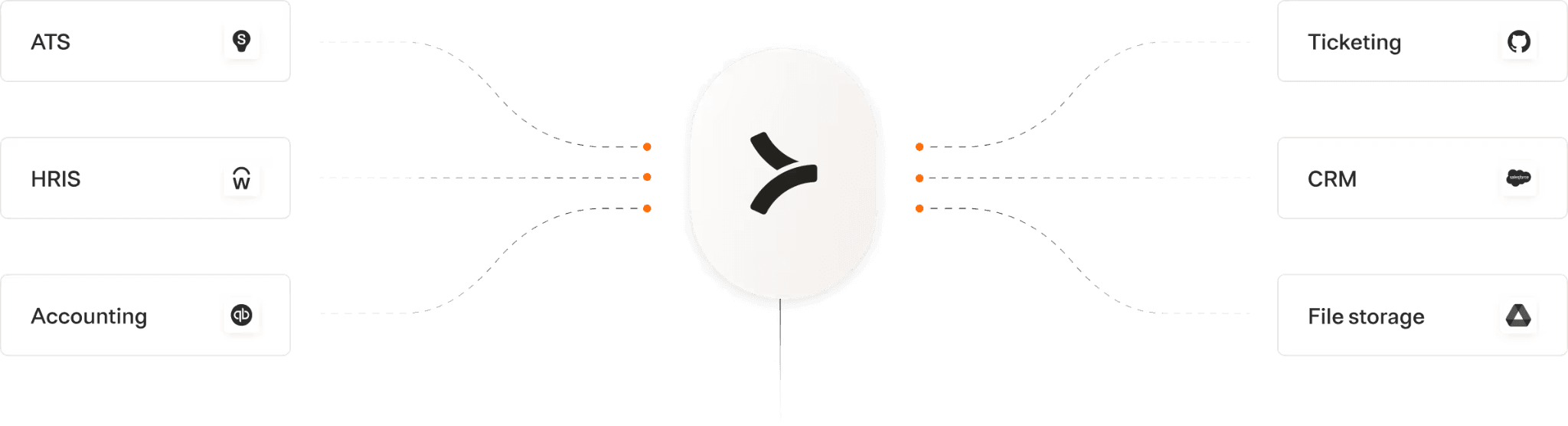
Merge normalizes many providers into common models behind a single API, and Merge Link provides customers with a clean authorization flow. Normalization pays off when a product needs to manage contacts, accounts, and deals across multiple CRMs within weeks. Conversation data fits the model poorly, since Gong trackers, talk tracks, and deal-risk fields have no equivalent in a shared schema, and syncs run on a scheduled cadence that cannot feed a sub-second agent loop.
Pros
- Common models across CRM and several adjacent categories
- Merge Link handles customer authorization
- Agent Handler provides MCP-ready access
Cons
- Shared schema drops CI-specific fields like trackers and talk tracks
- Scheduled cadence caps event freshness at minutes
Pricing: Free for up to 3 production link accounts. Launch plan at $650 per month for 10 linked accounts, with additional per-account charges. Professional and Enterprise tiers require annual contracts.
5. Unified
Best for: Products that want unified API and MCP access across call, meeting, and conversation data.
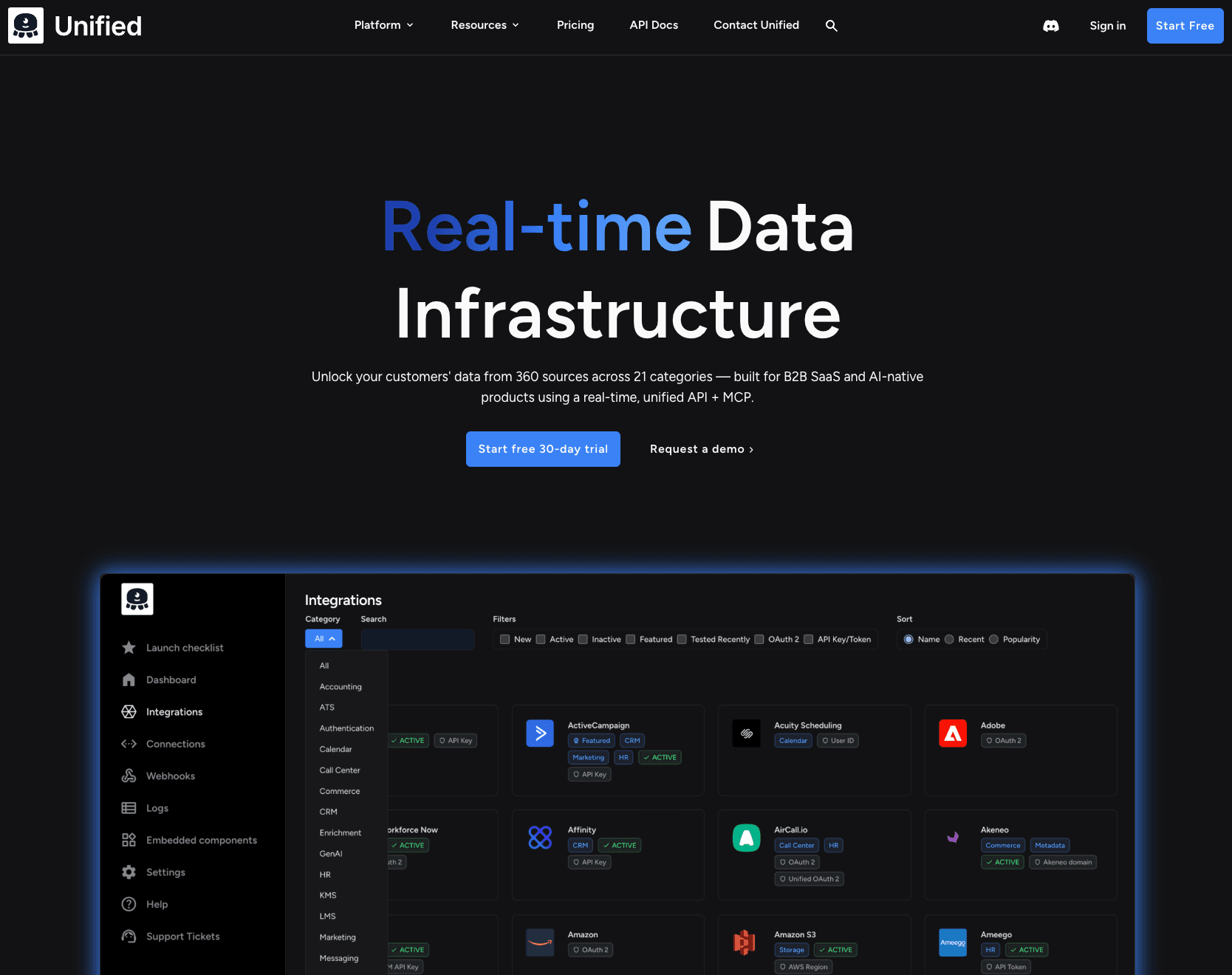
Unified provides a Gong integration through its Call Center API, covering calls, recordings, contacts, employee data, and direct passthrough requests. Its Fireflies integration supports meeting recordings and passthrough access, while the wider catalog includes Zoom, Zoom Phone, Dialpad, Fathom, Google Meet, and other communication tools. Embedded authorization lets customers connect their own accounts, and updates can be delivered via native or virtual webhooks.
Pros
- Coverage for Gong, Fireflies, Zoom, Zoom Phone, and adjacent tools
- Unified API, MCP, embedded authorization, and passthrough access
- Native and virtual webhook support
Cons
- Chorus and Otter are outside the current connector list
- Virtual webhooks use polling when native events are unavailable
Pricing: Paid plan starts at $750 per month with a free trial. Usage-based pricing by API request volume.
Conversational intelligence integration platforms compared (2026)
| Criteria | Ampersand | Paragon | Nango | Merge | Unified |
|---|---|---|---|---|---|
| CI-app coverage | ✅ Live Gong, Chorus, Fireflies, and Zoom connectors with provider-specific objects, fields, reads, and writes. | ⚠️ Native Gong integration with API access and workflow actions. Other CI tools may require custom integrations. | ⚠️ Auth templates for Gong, Chorus, Fireflies, and Zoom, with product-specific transcript logic written by the team. | ⚠️ Ready-made Agent Handler connectors for Gong and Fireflies. | ⚠️ Covers Gong, Fireflies, and Zoom through unified models and passthrough access, but not Chorus. |
| Real-time event delivery | ✅ Subscribe Actions deliver near-instant provider events, with retries and error handling managed by Ampersand. | ⚠️ Supports native webhook triggers and one-minute polling where webhooks are unavailable. | ⚠️ Supports provider webhooks and real-time syncs, but the team defines the event-processing logic. | ⚠️ Optimized for on-demand agent tool calls, with no continuous transcript event stream. | ✅ Live API requests with native and virtual webhooks. |
| Per-tenant OAuth at scale | ✅ Managed separately for every customer, including secure token storage, refreshes, retries, rate limits, and connection monitoring. | ✅ OAuth and API-key connections managed through the embedded Connect Portal. | ✅ Encrypted credential storage, automatic refresh, reconnect flows, and per-connection logs. | ✅ Runtime authentication through Magic Link, with OAuth or API-key support depending on the provider. | ✅ Managed authorization through an embeddable connection component. |
| Embedded customer setup UI | ✅ Prebuilt and headless React components for authentication, setup, object selection, field mapping, and connection management. | ✅ White-label and headless Connect Portal with user settings, workflows, and field mapping. | ⚠️ Embedded Connect UI covers authorization and reconnection; wider configuration is built by the product team. | ⚠️ Magic Link handles customer connection and runtime authorization. | ✅ Embedded authorization components for React, Angular, Vue, Svelte, JavaScript, and API-based setups. |
| AI-agent and MCP support | ✅ Multi-tenant MCP server and AI SDK use each customer’s credentials, permissions, and integration configuration. | ✅ ActionKit API and MCP server expose integration actions to agents. | ✅ TypeScript functions can be exposed through the API or Nango’s MCP server. | ✅ Agent Handler provides MCP-ready tools for Gong calls and Fireflies meetings, transcripts, and analytics. | ✅ Unified MCP provides agent access to supported API actions. |
| Code-first ergonomics | ✅ Integration definitions stay in Git-reviewed amp.yaml manifests alongside the product code. | ⚠️ Visual workflows remain the main authoring model. | ✅ Provider logic is written in TypeScript and can adhere to the team’s source control and deployment processes. | ⚠️ Tools are configured through Agent Handler, with limited connector logic owned in the product repository. | ⚠️ API- and SDK-first model, with most provider-specific behavior handled in the managed layer. |
Ready to ship real-time Gong, Chorus, and Fireflies connectors your customers configure themselves? Start building on Ampersand for free →
How to choose the right conversational intelligence integration platform
Conversational intelligence rarely works in isolation. AI SDRs, coaching tools, and revenue products often require sales engagement integrations and productivity and collaboration integrations alongside call data. Start with the tools your customers use, how quickly the data must reach your product, and how much connector logic your engineering team wants to maintain.
Choose Ampersand if your roadmap depends on provider-native call data from customer-owned accounts. The amp.yaml framework keeps event delivery, per-tenant OAuth, embedded setup, connection logs, and agent access under a single configuration model, so the integration surface expands with the customer base without new infrastructure work.
Choose Paragon when customer admins or low-code teams need a white-label setup portal and visual workflows for configuring integration behavior.
Choose Nango when engineers want direct control over provider-specific sync and webhook logic while using managed authentication and execution infrastructure.
Choose Merge when contacts, accounts, and standard call objects in a normalized schema cover your requirements and a scheduled sync cadence suits the product.
Choose Unified if a normalized API across Gong, Fireflies, Zoom, and adjacent call tools covers most of your data needs and passthrough requests can fill provider-specific gaps.
Why Ampersand leads for conversational intelligence integrations
Conversational intelligence products need integrations that can keep up as customer count, call volume, and product complexity increase. Ampersand gives engineering teams control over each provider’s native data while managing the infrastructure required to operate customer-facing integrations at scale. The same framework can also connect conversation data to the CRM, sales, and support systems used throughout the broader revenue workflow.
Teams at Crunchbase, Default, Vendelux, Clarify, and Warmly use Ampersand for native product integrations. Hatch’s CTO also credits Ampersand with removing months of ongoing integration maintenance, allowing the team to focus its engineering time on the product.
Build conversational intelligence integrations on Ampersand’s free tier →
FAQs: Conversational intelligence integration platforms in 2026
How do I integrate Gong with my SaaS product without having to maintain the connector?
A managed integration service can handle Gong authentication, token refresh, rate limits, retries, API updates, and customer-specific setup. Your engineers can work with Gong data through a consistent interface without maintaining the connector infrastructure themselves. Ampersand provides a ready-made Gong integration for customer-facing SaaS products.
Does Gong's API support real-time webhooks?
Gong can send a webhook through an automation rule after it finishes processing a call. The customer’s Gong administrator must configure the rule, and the total delivery time still depends on Gong’s processing window.
How do I support customers split between Gong and Chorus from a single framework?
Use one integration framework for authentication, customer setup, logs, retries, and event delivery while keeping Gong and Chorus data in their native formats. Ampersand supports Gong and Chorus through the same configuration model, so each customer can connect the system their sales team already uses.
How is OAuth refresh handled across customer Gong and Chorus accounts?
Every customer connection has its own access token, refresh schedule, permissions, and revocation process. The integration layer should automatically refresh tokens, isolate authentication failures to the affected account, and prompt the customer to reconnect when access cannot be restored. Ampersand manages this lifecycle per tenant, including secure token storage, automatic refresh, revocation, and reconnection.
Can my customers self-configure their own Fireflies connection inside my product?
Embedded setup components let customers authorize Fireflies, choose the data they want to sync, map fields, and reconnect expired credentials from within your product. Ampersand includes these customer-facing controls in its Fireflies integration, reducing the setup work handled by support and engineering teams.
What is the difference between conversation intelligence software and a conversational intelligence integration platform?
Conversation intelligence software records, transcribes, and analyzes calls or meetings. A conversational intelligence integration platform connects those systems to a SaaS product across many customer accounts and manages authentication, data delivery, configuration, and connector maintenance. The Ampersand integrations span conversation tools and the CRM, sales, support, and productivity systems that often provide the broader customer context.